

Read the Full Article on Commercial Observer - Click Here
New York City’s housing crisis is no longer abstract, it is visible in deteriorating public housing, rising rents, and shrinking affordability across every borough. Despite this reality, proposals that meaningfully increase housing supply often face resistance rooted in ideology, mistrust of private capital, and fear of change.
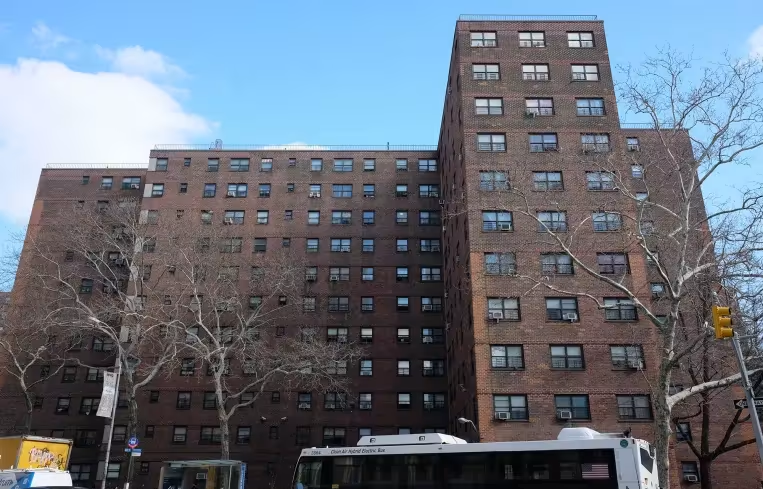
The proposed redevelopment of the Fulton and Elliott-Chelsea Houses highlights this contradiction. Far from displacing residents, the plan represents a scalable, data-driven solution to rebuild failing public housing, improve living conditions, and unlock underutilized land to deliver thousands of new homes in one of the city’s most transit-rich locations.
Legal challenges to the Chelsea project illustrate how procedural resistance can delay substantive progress. A recent ruling denying an attempt to block the redevelopment acknowledged a core reality: NYCHA is chronically underfunded, and redevelopment replaces failing buildings with new housing for all current residents. Preserving uninhabitable structures in the name of stewardship does not protect tenants—it prolongs neglect.
If redevelopment succeeds in Chelsea, it should not be an exception. Across Manhattan alone, unlocking unused air rights on NYCHA land could generate tens of millions of square feet of housing and potentially 100,000 new units. Citywide, the impact would be transformative. The housing crisis is a supply problem, and supply-side solutions must be pursued at scale.
No. The Chelsea plan guarantees brand-new apartments for all current residents, improving living conditions without displacement.
With an $80 billion repair backlog and shrinking federal funding, repair-only strategies are financially unrealistic and fail to address long-term structural deficiencies.
Private capital provides equity, construction expertise, and execution capacity that the public sector lacks, making large-scale redevelopment financially viable.
By adding thousands of new units on underutilized land, redevelopment increases overall supply, easing upward pressure on rents citywide.
Yes. Dozens of NYCHA sites across all five boroughs could support similar redevelopment, delivering housing at a scale few other strategies can match.

Get tailored industry and listing news, Map Room, and Bob Knakal's insights in your inbox!

Follow us on


