

Executive Summary
For more than forty years we have tracked every investment property sale in Manhattan south of 96th Street, a universe of 27,649 buildings. Over that time one statistic has remained remarkably consistent: the annual turnover rate. On average, approximately 2.5 percent of Manhattan investment properties change ownership in a given year, meaning that roughly 691 buildings trade annually and the typical owner holds a property for approximately forty years after purchasing it.
Turnover in the Manhattan investment sales market follows clear cycles that closely track economic conditions. Over the past four decades, every major spike in unemployment — including the recessions of 1992, 2003, 2009, and the COVID shock in 2020 — coincided with some of the lowest turnover levels recorded in the market. As unemployment rises and economic confidence declines, investors pause acquisitions and lenders tighten underwriting standards, causing transaction activity to contract sharply. Once employment stabilizes and capital returns, turnover typically rebounds quickly.
Tax policy has also played a significant role in shaping the timing of market activity. Major federal tax changes, particularly those affecting capital gains, have historically produced some of the strongest transaction years in Manhattan. The Tax Reform Act of 1986, the Taxpayer Relief Act of 1997, and the implementation of the 3.8 percent Net Investment Income Tax under the Affordable Care Act all triggered substantial spike in investment sales activity as owners accelerated transactions ahead of changing tax consequences.
The current cycle has been shaped by an additional force: regulatory changes affecting rent-regulated housing. The 2019 Housing Stability and Tenant Protection Act dramatically altered the economics of rent-stabilized buildings, leading to significant value declines and creating a growing number of properties caught between owners unwilling to invest additional capital and lenders reluctant to assume ownership. This dynamic has effectively frozen a meaningful portion of the market and contributed to the longest period of below-trend turnover observed in more than four decades of data.
History suggests that such periods rarely persist indefinitely. When financial pressures eventually force resolution — through loan restructurings, note sales, short sales, foreclosures, and renewed capital flows — the Manhattan investment sales market has historically entered periods of rapid expansion. Given the unusually long duration of the current slowdown, the next phase of the market cycle may produce one of the most significant waves of transaction activity seen in decades.
The Long Drought in Manhattan Investment Sales
Understanding 42 Years of Turnover — and Why the Next Cycle May Be Forming
For more than four decades I have been tracking investment property sales in Manhattan south of 96th Street. Within this market there are 27,649 investment properties, and since 1984 we have meticulously tracked every sale that has occurred. Over those forty-two years we have assembled one of the most comprehensive ownership datasets ever compiled for Manhattan real estate. When you analyze that history, one statistic stands out above all others: the annual turnover rate of investment properties.
Turnover measures how frequently ownership changes within the market. In Manhattan south of 96th Street, the long-term average turnover rate since 1984 has been approximately 2.5 percent per year. That means that in a typical year roughly 691 buildings change hands. Another way to interpret that statistic is through ownership duration — if the turnover rate is 2.5 percent, the average owner holds a property for approximately forty years after purchasing it.
That statistic surprises many people because real estate is often perceived as a highly transactional business. In reality, ownership of Manhattan investment properties tends to be extraordinarily long term. Buildings frequently remain in the same hands for decades and often pass through multiple generations of ownership. Because holding periods are so long, even relatively small changes in turnover can signal meaningful shifts in market conditions.
Over time, turnover rates tend to move in cycles that reflect broader economic forces. Periods of expanding capital availability and economic growth tend to produce increased transaction activity. Conversely, recessions and financial disruptions suppress turnover as investors become cautious and lenders tighten underwriting standards. As a result, turnover is not simply a real estate metric; it is closely tied to the broader economic environment.
The Relationship Between Unemployment & Turnover
One of the strongest correlations in the forty-two-year dataset is the relationship between unemployment levels and Manhattan investment sales turnover. The relationship is strongly negative — as unemployment rises, transaction activity tends to fall sharply. This pattern has repeated itself consistently across multiple economic cycles.
Four clear periods illustrate this relationship: 1992, 2003, 2009, and 2020. In each of these years unemployment reached cyclical peaks both nationally and in New York City. At the same time, Manhattan investment sales turnover dropped to some of the lowest levels recorded in the dataset.
The first example occurred in 1992 during the aftermath of the Savings and Loan crisis. That year New York City unemployment reached approximately 7.5 percent, while national unemployment climbed to 11.1 percent. In that same year Manhattan investment sales turnover dropped to 1.6 percent, a cyclical low.
A similar dynamic occurred in 2003 following the dot-com collapse, the September 11 attacks, and the recession that followed. New York City unemployment reached approximately 6 percent while national unemployment rose to 8.4 percent. Once again turnover dropped to 1.6 percent , a cyclical low.
The relationship was even more pronounced during the Great Financial Crisis. In 2009 New York City unemployment reached 9.4 percent while national unemployment climbed to 10 percent. During that same year Manhattan investment sales turnover fell to just 1.2 percent, the lowest level recorded in the forty-two-year dataset.
The most recent example occurred during the COVID pandemic in 2020. New York City unemployment reached 8.1 percent while national unemployment spiked to 12.4 percent. As economic uncertainty spread through financial markets, Manhattan investment sales turnover fell to 1.4 percent, yet another cyclical low.
These four examples demonstrate the powerful influence that employment conditions have on investment sales activity. When unemployment spikes, capital retreats and investors delay acquisitions. Once employment stabilizes and economic confidence returns, transaction activity tends to rebound quickly.
Turnover Rate (1984 - 2025)
.avif)
The Impact of Tax Policy on Market Turnover
Tax policy has historically played an important role in shaping the timing of investment sales activity. Unlike many economic forces that evolve gradually, tax legislation often creates clear deadlines that influence investor behavior. When investors know that tax consequences will change at a specific date, transaction activity frequently accelerates.
When capital gains taxes are scheduled to increase, the higher rates typically take effect on January 1 of the following year. This creates strong incentives for property owners to complete transactions before the new rates are implemented. As a result, markets often experience significant spikes in sales activity in the months leading up to those changes.
Conversely, when capital gains taxes are reduced, those reductions are often retroactive to the beginning of the year in which the legislation is enacted. Once investors recognize that the lower rates apply to the current year, many accelerate plans to sell assets to take advantage of new net gains in value.. This structure can also produce meaningful spikes in transaction activity.
Several of the most significant turnover spikes in Manhattan history occurred during periods when federal tax legislation changed investment incentives. The Tax Reform Act of 1986 dramatically altered the treatment of real estate investments and eliminated many tax shelters that had previously driven capital into the sector. As investors repositioned portfolios in response to the new tax environment, Manhattan investment sales turnover surged in 1986.
Another major example occurred following the Taxpayer Relief Act of 1997, which reduced the federal capital gains tax rate from 28 percent to 20 percent. The lower tax rate improved after-tax investment returns and created strong incentives for owners to transact. In the year following the legislation, Manhattan investment sales turnover surged to 3.9 percent in 1998, a cyclical low.
A third example occurred in advance of the Net Investment Income Tax introduced by the Affordable Care Act, which added a 3.8 percent tax on investment income beginning in 2013. Because this tax effectively increased capital gains burdens, many property owners rushed to sell assets before the higher tax took effect. As a result, Manhattan investment sales turnover reached its highest level ever recorded — 4.3 percent in 2012.
These examples illustrate how tax policy can act as a catalyst for transaction activity. When tax changes are anticipated, investors often accelerate decisions that might otherwise have been delayed. As a result, tax legislation frequently influences not only investment returns but also the timing of entire market cycles.
The Rent-Stabilized Housing Policy Shock
While economic cycles and tax policy have historically shaped turnover patterns, the current market has been influenced by a different type of policy shock. The passage of the 2019 Housing Stability and Tenant Protection Act (HSTPA) dramatically altered the economics of rent-regulated housing across New York City.
Many apartment buildings that were once stable long-term investments suddenly became extremely difficult to finance, operate, and reinvest in. In numerous cases the value of rent-stabilized properties has declined as much as 75 percent since the legislation was enacted.
Many of these buildings were financed prior to 2019 at leverage levels that lenders believed were conservative — often around 50 percent loan-to-value. When property values fall by 50 to 75 percent, however, the financial structure supporting those assets collapses. In many cases the entire equity position has been wiped out.
Under normal market conditions this level of financial distress would produce a wave of foreclosures and distressed sales. Instead many of these buildings have entered a form of financial stagnation.
Owners often no longer want the buildings and would willingly hand back the keys. Lenders, however, frequently do not want to assume ownership because rent-regulated buildings carry substantial regulatory obligations and limited revenue growth potential.
The result is a growing number of buildings stuck in what can best be described as financial no-man’s land. Owners have little incentive to invest additional capital, while lenders are reluctant to foreclose. This unusual dynamic has frozen a meaningful portion of the Manhattan investment sales market and is leading to the degrading of housing stock quality and living conditions for residents, all thanks to our policy makers.
Unemployment vs. Turnover (1984 - 2025)
.avif)
Historical Turnover Cycles
Over the past forty-two years Manhattan investment sales turnover has moved in clear cycles. Periods of suppressed activity are typically followed by periods of rapid expansion once financial conditions stabilize.
Turnover reached 3.5 percent in 1988 during the final years of the 1980s real estate boom. Just a few years later, the early-1990s recession pushed turnover down to 1.6 percent.
Once the market stabilized, activity accelerated quickly. By 1998 turnover had reached 3.9 percent.
A similar pattern occurred during the following decade. Turnover reached a cyclical low of 1.6 percent in 2003 before surging to 3.4 percent in 2006.
During the Great Financial Crisis turnover fell to 1.2 percent in 2009 before surging to an all-time high of 4.3 percent in 2012.
During the COVID pandemic in 2020 turnover fell again to 1.4 percent. Since that time activity has improved modestly but has remained below the long-term average and we are currently in the midst of the longest period of below trend turnover recorded during our study period.
How to Read the 42-Year Turnover Graphs in This Report
The graphs accompanying this report illustrate the annual turnover rate of Manhattan investment properties south of 96th Street over the past forty-two years. The turnover rate represents the percentage of the 27,649 investment properties in this market that change ownership in a given year.
Several patterns become clear when examining the dataset. Turnover moves in cycles with pronounced peaks and troughs corresponding to major economic events. These include the early-1990s recession, the early-2000s downturn, the Great Financial Crisis, and the COVID pandemic.
The graphs also reveal the unusually long stretch of below-trend turnover occurring today. Unlike previous downturns, the current cycle has remained suppressed for a longer period. This suggests that structural factors — particularly policy changes affecting rent-regulated housing — have extended the current slowdown beyond what would normally occur in a typical economic cycle.
What This Means for Owners Considering a Sale in the Next 2–5 Years
For owners of Manhattan investment properties, the historical turnover data provides important insights into where the market may be heading. Periods of suppressed activity do not persist indefinitely. Over time financial pressures build until lenders, owners, and investors are forced to resolve outstanding issues.
The current market appears to be approaching one of those inflection points. A significant portion of the distress created by regulatory changes and rising interest rates has not yet fully worked through the system. As lenders gradually recognize impairments within their loan portfolios, we are likely to see increased activity through note sales, restructurings, foreclosures, and distressed transactions.
Once that process begins, transaction activity can accelerate quickly. Investors who have been waiting on the sidelines often step in aggressively once pricing becomes clearer and financing markets stabilize. Historically, some of the strongest transaction environments in Manhattan have followed periods of unusually low turnover.
For that reason, owners who are considering a sale within the next two to five years may benefit from closely monitoring these indicators. As the financial logjam begins to break, the Manhattan investment sales market may enter another dynamic phase of price discovery and ownership change.
If the past forty-two years of data teach us anything, it is that long droughts in Manhattan investment sales activity are often followed by powerful market surges. Given the extraordinary length of the current slowdown, the next expansion could prove to be one of the most significant cycles we have seen in decades.

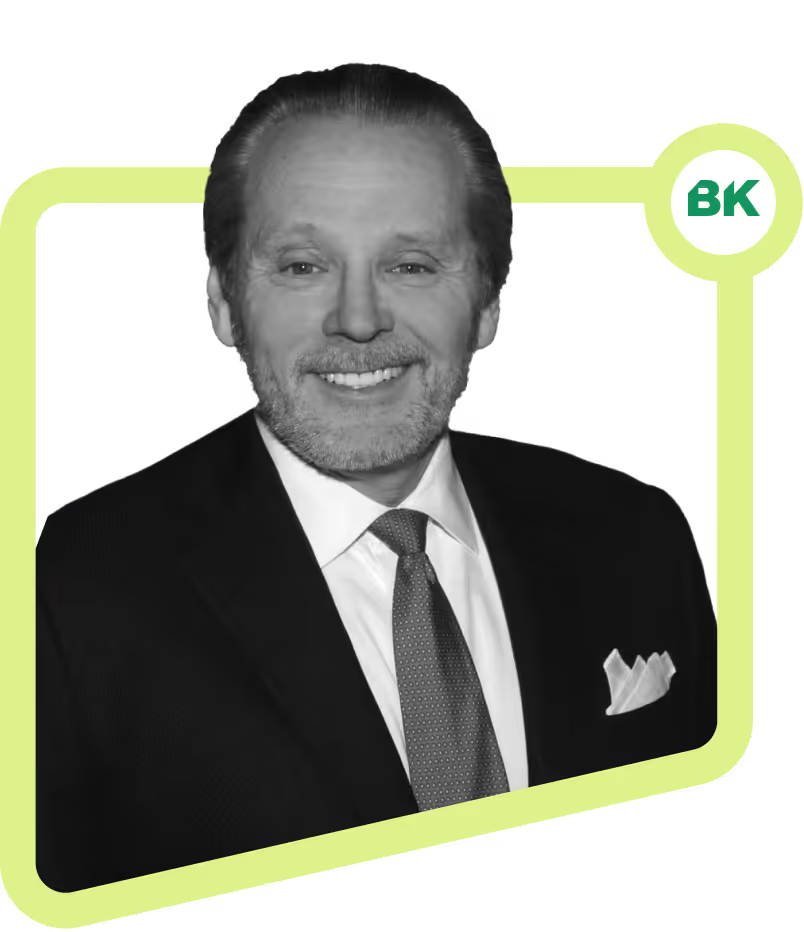
Bob Knakal | Chairman & CEO
bk@bkrea.com | 917.509.9501
Bob Knakal has been a broker in NYC since 1984. Over that time, he has brokered the sale of over 2,422 buildings having a market value of approximately $24.8 billion. The 2,422 properties sold Is generally considered to be the highest total for any individual broker in the history of the United States.
For 26 years of those years (1988-2014), he owned and ran Massey Knakal Realty Services which sold more than 3x the number of properties as the #2 firm in NYC from 2001-2014. Running the firm with a Servant Leadership management style, focusing on empowering everyone on the team, intensely training them and building their self-esteem, led to this overwhelmingly dominant platform. The firm was sold to Cushman & Wakefield in 2014 for $100 million.
The Massey Knakal Legacy is illustrated by the fact that today in the New York City investment sales market, there are 35 companies, or divisions of companies, that are either owned by, or run by, folks who learned the business at Massey Knakal.
Bob is a prominent thought leader in the commercial real estate business, frequently writing about the market, lecturing on the market, and appearing on podcasts and national television shows on networks like Fox, CNBC and MSNBC.