


The Rules of Value Are Changing
- Time Risk Is Being Compressed: What once took years may now move with greater speed and predictability
- More Capital Is Entering the Market: Institutional and opportunistic developers can now pursue sites they once avoided
- Not Every Site Will Benefit: Eligibility, positioning, and strategy will determine where value is created
- The “Uncertainty Discount” Is Shrinking: Less entitlement risk means less value leakage from sellers to buyers
- Competition Is Increasing—Meaningfully: More qualified buyers create stronger bidding environments and pricing tension
- The Advantage Goes to the Informed: Early recognition of ELURP-driven opportunities can produce outsized results
"When entitlement risk declines, value does not adjust gradually—it reprices. And in New York City, that repricing can mean tens of millions of dollars." — Bob Knakal
ELURP: The Beginning of a Faster Path to Value in New York City Development
At BKREA, everything we do is built around one central idea: providing our clients with information that allows them to make better decisions and, ultimately, achieve better outcomes. In a market as complex and dynamic as New York City, information is not just helpful, it is the primary driver of value. The owners who understand where the market is going, not just where it has been, are the ones who consistently outperform. That is particularly true in the part of the market where we spend the greatest amount of our time and attention: development.
Our firm is more heavily focused on ground-up development and redevelopment opportunities than on any other vertical. We spend virtually all of our time analyzing development sites, vacant buildings, and repositioning scenarios. We track zoning changes, study development pipelines, monitor capital flows, and engage daily with the developers who are actively shaping the city’s future. That vantage point gives us a unique ability to identify inflection points, moments where policy, capital, and market demand intersect to create meaningful new opportunities for value creation. When those moments occur, the owners who recognize them first are the ones who capture the greatest share of that value. ELURP is one of those moments.
For decades, there has been one acronym that has quietly dictated the pace, risk profile, and ultimately the pricing of development sites in New York City: ULURP.
It is not an overstatement to say that ULURP, the Uniform Land Use Review Procedure, has been one of the most consequential forces shaping our built environment. It determines how long projects take, how much they cost, and, in many cases, whether they happen at all. It was designed to create transparency and community input, and those are important objectives. But over time, it has also become one of the most significant bottlenecks to housing production and economic growth in our city. More importantly from an owner’s perspective, it has introduced a level of time risk and uncertainty that has historically been reflected in lower land values.
Now, New York City has introduced a new concept: ELURP, an expedited version of ULURP. While it may sound like a technical adjustment, it has the potential to fundamentally reshape how value is created, and more importantly, how that value is distributed, in the development market. If implemented effectively, and that is a very important caveat, ELURP could become one of the most impactful changes to the New York City real estate development ecosystem in decades.
What ELURP Is and Why It Matters
At its core, ELURP is an attempt to solve a problem that everyone in the industry understands but few have been able to fix: time.
Traditional ULURP is a structured, multi-step public review process that typically takes seven months at a minimum, and in reality often stretches far longer when you factor in pre-certification work, environmental review, political negotiation, and post-approval conditions. In many cases, the full lifecycle of a rezoning can extend to 18 to 36 months or more. That time is not neutral. Time introduces risk, increases carrying costs, creates uncertainty around capital markets, interest rates, and construction pricing, and, most importantly, reduces the number of projects that actually get built.
But from a valuation perspective, there is an even more important implication: time transfers value away from owners and toward risk-tolerant capital.
In a city with a 1.4 percent vacancy rate in the housing market, creating new supply is not just important, it is essential. Yet the longer and more uncertain the entitlement process becomes, the more that uncertainty gets priced into land, often at the expense of the seller.
ELURP is designed to compress that timeline. While the exact parameters are still evolving, the fundamental concept is straightforward: create a faster, more predictable approval pathway for projects that meet certain predefined criteria. Instead of subjecting every project to the same lengthy process, ELURP aims to identify categories of development that can move through a streamlined version of ULURP with fewer procedural delays.
In simple terms, ELURP has the potential to do something very powerful: reduce the uncertainty discount that has historically been embedded in development site pricing.
ULURP vs. ELURP: The Key Differences
To understand why ELURP matters, you have to understand how it differs from ULURP in practical terms.
ULURP is deliberately comprehensive. It involves multiple layers of review, including the Community Board, Borough President, City Planning Commission, City Council, and, in some cases, the Mayor’s office. Each step has defined timeframes, but the process as a whole is sequential and inherently political. ELURP, by contrast, is intended to be selective, targeted, and faster, with greater emphasis on predictability and alignment with pre-established planning goals.
The key differences can be distilled into four principal areas.
First, timeline compression. ULURP’s formal review period is approximately seven months, but the real-world timeline is often significantly longer. ELURP aims to shorten both the formal review window and the pre-certification phase, which can often take years, potentially reducing the total approval timeline in a meaningful way.
Second, eligibility-based processing. ULURP applies broadly to rezonings and land use actions. ELURP is expected to apply only to projects that meet specific criteria, such as those aligned with housing production goals, transit-oriented development, utilization of underbuilt sites, or sites located within designated zoning districts.
Third, reduced procedural friction. ULURP requires full sequential review. ELURP is expected to streamline or consolidate certain steps, reducing redundancy and limiting opportunities for delay.
Fourth, and perhaps most importantly, greater predictability. The most meaningful distinction may not be speed, but certainty. ULURP outcomes are often influenced by shifting political dynamics. ELURP is intended to create a more rules-based framework in which qualifying projects have a clearer path to approval and, in some cases, may not require City Council approval.
What ELURP Applies To
ELURP is not intended to replace ULURP entirely. It is a targeted tool designed to accelerate projects that align with the city’s broader objectives.
Based on how the program is being discussed, ELURP is most likely to apply to housing-focused rezonings that increase supply, as-of-right adjacent modifications where changes are incremental rather than transformational, transit-oriented development where increased density aligns with infrastructure capacity, underutilized or underbuilt sites in areas already identified for growth, and projects that meet affordability or other public policy objectives.
In other words, ELURP is designed to accelerate projects that the city already wants to see happen. That alignment is important, not just from a policy standpoint, but from a pricing standpoint as well.
Because when entitlement risk is reduced on projects the city supports, competition for those sites increases.
And when competition increases, values follow.
Program Parameters: The Guardrails
While the full rulebook is still taking shape, several likely parameters are emerging that will define how ELURP operates. Projects will likely need to meet clearly defined eligibility criteria, whether related to density thresholds, affordability components, geographic location, or a combination of those factors. The review process is expected to rely more heavily on standardized planning frameworks, reducing subjectivity and limiting open-ended negotiation.
At the same time, projects requiring significant deviations from established zoning principles are unlikely to qualify, and the program may be geographically targeted toward neighborhoods and corridors where infrastructure can support additional density. These guardrails will determine where ELURP creates value, and equally important, where it does not.
Who ELURP Applies To
ELURP is relevant to three primary constituencies, but the impact is not evenly distributed.
Property owners stand to benefit from increased optionality and, more importantly, improved pricing dynamics. A site that previously required a lengthy and uncertain rezoning process may now have a clearer and faster path to unlocking additional value. Developers benefit
from reduced entitlement risk and shorter timelines, which directly improve feasibility. Capital providers benefit from increased certainty, making it easier to underwrite and finance projects.
But it is important to be clear about one point: when risk is reduced and timelines are compressed, the value created should not be assumed away by the market.
It should be captured.
Where ELURP Will Be Most Effective
Not every part of New York City will benefit equally from ELURP. The program will be most effective in areas where several conditions are present at the same time: strong underlying demand for additional density, sufficient infrastructure capacity, a demonstrated need for additional housing production, and alignment with city planning objectives.
In practical terms, this points to prime Manhattan corridors, transit-rich areas in Brooklyn and Queens, underbuilt sites in established residential neighborhoods, and commercial corridors undergoing repositioning. It may also prove particularly effective in areas that have historically underproduced housing relative to their location, infrastructure, and market demand.
These are the locations where reduced entitlement friction will translate most directly into increased land values.
The Owner’s Perspective: Capturing the Value Shift
From an owner’s standpoint, ELURP has the potential to fundamentally change how assets are valued. Historically, sites requiring rezoning carried a significant uncertainty discount, as buyers priced in the time, cost, and risk associated with ULURP. In many cases, that discount was substantial.
ELURP has the potential to narrow that gap, and in some cases, eliminate a portion of it entirely.
If a site qualifies for expedited review, the perceived risk profile changes. That can lead to more interested parties, deeper pools of capital, more competitive bidding, and ultimately higher pricing. Institutional developers, who may have previously avoided certain opportunities due to entitlement risk, may now become active participants. Marketing timelines can shorten, and pricing tension can increase.
At BKREA, this is where strategy becomes critical.
The question is no longer simply what the site is worth today. The question becomes what the site is worth in a market where entitlement risk has been structurally reduced. That distinction can be worth tens of millions of dollars on the right asset. Our role is to identify that opportunity, frame it properly, and ensure that the seller, and then the market, fully recognize and compete for that value.
The Developer’s Perspective: Opportunity and Discipline
For developers, ELURP creates real opportunity, but it also introduces a need for discipline.
Faster timelines, greater predictability, and reduced entitlement risk all improve project feasibility. Every month shaved off the entitlement process reduces carrying costs, improves financing terms, and expands the pool of viable projects. In volatile capital markets, that kind of compression can materially impact returns.
At the same time, as entitlement risk declines, competition for sites will increase. Developers who move early, who understand the nuances of ELURP, and who are able to identify qualifying sites before they are widely recognized will have a significant advantage.
But over time, as the market adjusts, that advantage will be competed away.
Which is why timing, and information, matter.
How BKREA Advises Clients to Leverage ELURP
At BKREA, we view ELURP not simply as a policy change, but as a strategic inflection point.
For owners, that means evaluating whether a site may qualify, quantifying the value impact of expedited approval, positioning the opportunity in a way that fully reflects that upside. It also means targeting the developers most capable of executing within the ELURP framework and creating a competitive environment that forces the market to recognize that value.
For developers, it means identifying eligible sites early, moving quickly to secure control, designing projects that fit within the program’s parameters, and leveraging the shortened timeline to optimize capital structure and returns.
In both cases, information is the differentiator. The developers who understand ELURP earliest, and the owners who are best advised on how to position that advantage, will be the ones who benefit most.
The Risks, and Why Execution Matters
ELURP is not a guaranteed solution. Its success will depend entirely on execution.
If eligibility criteria are too narrow, the program’s impact will be limited. If political dynamics re-enter the process in a meaningful way, predictability will diminish. If implementation is inconsistent, confidence in the program will erode.
But the direction is clear. Policymakers are increasingly recognizing that the current process is too slow and that housing supply is the only long-term solution to the city’s housing challenges.
The Bottom Line
For years, the development community has operated within a system where time has been one of the greatest obstacles to value creation. ELURP represents a meaningful shift in that dynamic.
It is not a complete overhaul. It is not a silver bullet. But it is a step toward a more efficient, more predictable, and more productive development environment.
And for sellers, it represents something even more important: an opportunity.
An opportunity to reduce the uncertainty discount,
An opportunity to expand the buyer pool,
An opportunity to increase competitive tension,
And ultimately, an opportunity to achieve higher pricing.
For developers, it represents a chance to move faster, deploy capital more efficiently, and scale activity in a more predictable environment.
For the market as a whole, it has the potential to increase transaction activity and, ultimately, increase supply.
But as is always the case in New York City real estate, the greatest benefits will accrue to those who recognize the shift early and act on it decisively.
Because in this market, value does not simply appear.
It is identified, positioned, and captured.


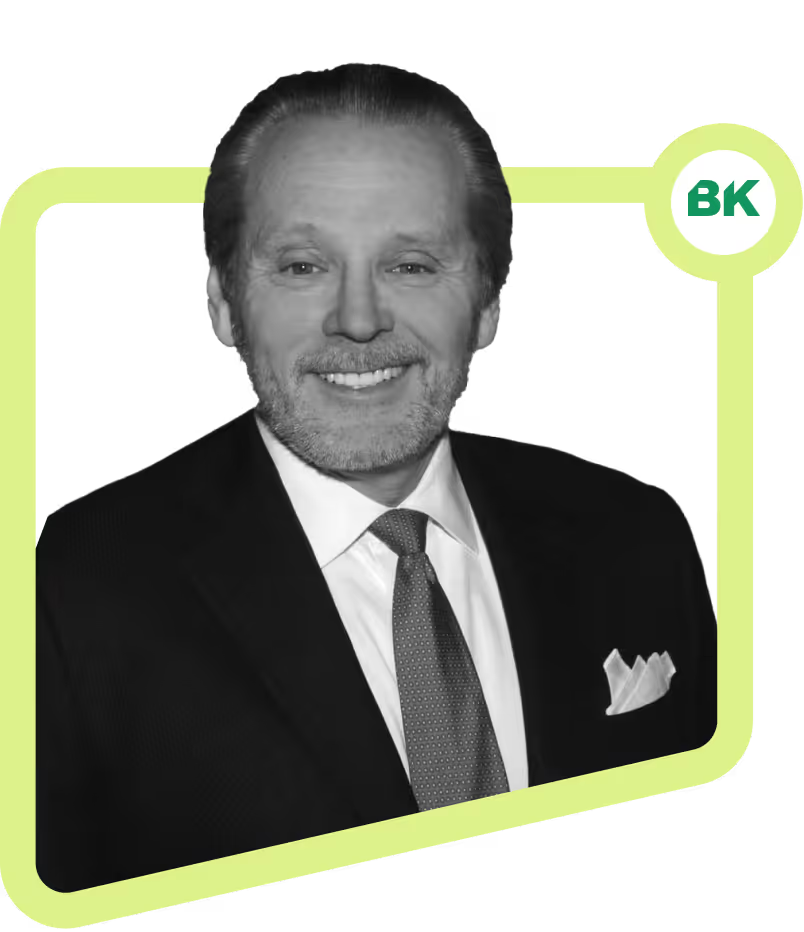
Bob Knakal | Chairman & CEO
bk@bkrea.com | 917.509.9501
Bob Knakal has been a broker in NYC since 1984. Over that time, he has brokered the sale of over 2,425 buildings having a market value of approximately $24.9 billion. The 2,425 properties sold Is generally considered to be the highest total for any individual broker in the history of the United States.
For 26 years of those years (1988-2014), he owned and ran Massey Knakal Realty Services which sold more than 3x the number of properties as the #2 firm in NYC from 2001-2014. Running the firm with a Servant Leadership management style, focusing on empowering everyone on the team, intensely training them and building their self-esteem, led to this overwhelmingly dominant platform. The firm was sold to Cushman & Wakefield in 2014 for $100 million.
The Massey Knakal Legacy is illustrated by the fact that today in the New York City investment sales market, there are 35 companies, or divisions of companies, that are either owned by, or run by, folks who learned the business at Massey Knakal.
Bob is a prominent thought leader in the commercial real estate business, frequently writing about the market, lecturing on the market, and appearing on podcasts and national television shows on networks like Fox, CNBC and MSNBC.