


Executive Summary
For decades, commercial real estate brokerage was primarily an information and relationship business.
Property owners selected brokers based upon referrals from trusted advisors, recommendations from friends and colleagues, prior experiences, and personal relationships developed over many years. While those factors remain critically important today, the process by which owners identify, evaluate, and ultimately hire brokers is changing rapidly. Before speaking with a broker, many owners now conduct extensive independent research. They search online, watch videos, listen to podcasts, read articles, review social media content, and increasingly ask artificial intelligence platforms such as ChatGPT for guidance.
As a result, reputation is no longer confined to personal networks. Reputation has become searchable. This shift represents one of the most significant changes in business development that the commercial real estate brokerage industry has experienced in decades. Firms and professionals who understand this evolution and adapt will have a meaningful competitive advantage in the years ahead.
The Evolution of Broker Selection
For much of the modern history of commercial real estate brokerage, the path to securing an assignment followed a relatively predictable sequence. An owner would decide to sell a property, seek recommendations from attorneys, accountants, lenders, friends, or business associates, interview several brokers, and ultimately make a selection. In many cases, the owner knew relatively little about the brokers beyond their personal interactions, reputation within a limited network, and whatever information was presented during the interview process. The brokerage presentation often served as the owner's first meaningful exposure to the broker's expertise, track record, and approach.
Today, that process looks very different. Long before a broker is invited to make a presentation, the owner has frequently begun conducting extensive research. The owner may spend hours or even days gathering information before scheduling a single meeting. Questions that previously would have been directed exclusively to trusted advisors are now being directed to search engines and artificial intelligence systems.
Owners increasingly ask questions such as: "Who is the best broker to sell my building?" "Who specializes in development sites?" "Who dominates multifamily sales in Manhattan?" "Who understands office conversions?" "Which brokers should I interview?" The answers to these questions are no longer determined solely by personal referrals or the size of a firm's sign inventory. They are increasingly influenced by a broker's digital presence, publicly demonstrated expertise, and the breadth of information available online.
In many respects, the interview process now begins long before the interview itself. By the time an owner sits down with a broker, opinions have often already been formed. The owner may have watched interviews, read articles, reviewed market studies, listened to podcasts, examined social media content, and searched for evidence supporting the broker's claims. The brokerage presentation is no longer the beginning of the sales process. Increasingly, it is somewhere in the middle.
AI Is Not Replacing Referrals—It Is Validating Them
One of the most common misconceptions surrounding artificial intelligence is the belief that it will replace traditional referral networks. In reality, the opposite may be occurring. AI is not replacing referrals. It is validating them.
Historically, if an attorney, accountant, lender, or trusted friend recommended a broker, that recommendation often led directly to a phone call. Today, the recommendation frequently serves as the starting point rather than the conclusion. Before reaching out, owners increasingly conduct their own due diligence. They search online. They read articles. They review transaction histories. They watch videos. They listen to interviews. They ask AI systems for additional perspective. They seek confirmation that the recommendation is supported by evidence.
This seemingly small shift has enormous implications. It means that reputation is no longer limited to what others say about you. It is increasingly influenced by what information exists about you. A broker may have an excellent reputation among peers and clients, but if there is little publicly available evidence of that expertise, owners may struggle to discover it. Conversely, brokers who consistently publish insights, educate the marketplace, and share their expertise create a substantial body of evidence that reinforces and validates their reputation.
How Artificial Intelligence Evaluates Expertise
What makes this evolution particularly interesting is that artificial intelligence systems often evaluate brokers differently than brokers evaluate themselves. Many brokerage firms continue to emphasize traditional corporate metrics such as the number of offices, number of employees, geographic footprint, years in business, or overall company size. While these factors may contribute to credibility, they do relatively little to distinguish one broker from another.
Artificial intelligence tends to focus on evidence. It evaluates transaction history, demonstrated specialization, published research, market commentary, educational content, podcast appearances, media interviews, speaking engagements, articles, videos, and third-party validation. In short, AI looks for proof. It looks for signals that indicate expertise. It looks for consistency. It looks for specialization. It looks for evidence that a broker understands a particular market, asset class, or transaction type at a deeper level than competitors.
The brokers who consistently create educational content, publish market intelligence, and contribute insights to the marketplace generate far more signals for AI systems to evaluate. Over time, these signals compound. The result is greater visibility, greater discoverability, and greater credibility.
The Growing Value of Specialization
Artificial intelligence is also accelerating a broader trend toward specialization. Generalists are increasingly difficult to differentiate. Specialists are easier to identify, easier to understand, and easier to recommend.
When an owner asks an AI system "Who specializes in development sites, office conversions, multifamily buildings, or a specific neighborhood", the brokers who have spent years creating content and demonstrating expertise in those areas enjoy a substantial advantage. Their specialization is easier to verify because evidence exists. Their expertise is supported by articles, interviews, studies, presentations, and transaction histories that reinforce their position in the marketplace.
This mirrors developments occurring across numerous professions. Patients seek medical specialists. Businesses seek specialized consultants. Clients seek attorneys with focused expertise. Commercial real estate is increasingly following the same pattern. As information becomes more accessible, expertise becomes more transparent. As expertise becomes more transparent, specialization becomes more valuable.
The Rise of the Brokerage Media Company
IOne of the most fascinating consequences of this transformation is that successful brokerage firms are increasingly becoming media companies. Historically, brokerage marketing was largely assignment-driven. Marketing materials were created to support active listings and specific transactions. Today, content serves a much broader purpose.
Every article, podcast appearance, interview, white paper, market study, presentation, social media post, video, and educational piece contributes to a firm's digital reputation. Collectively, these materials create a body of evidence that demonstrates expertise and authority. The firms that consistently educate the marketplace become easier to discover, easier to trust, and easier to understand.
This does not mean brokers must become entertainers or influencers. It means brokers must become educators. The market increasingly rewards professionals who share knowledge, explain trends, provide insight, and contribute meaningful information. In many respects, the brokerage firms of the future will operate partly as information companies. Their ability to create and distribute knowledge may become nearly as important as their ability to market individual properties.
The BKREA Approach
At BKREA, this trend reinforces a philosophy that has guided our business for decades: commercial real estate brokerage is fundamentally an information business. Superior information creates superior decisions. Superior intelligence creates superior outcomes. As a result, BKREA has invested heavily in proprietary research, market intelligence, educational content, and data-driven analysis.
The Knakal Land Index analyzes thousands of development site transactions to identify market relationships and valuation patterns. The Knakal Map Room tracks development activity throughout Manhattan and provides unique insight into emerging trends. Our Developer Ranking System evaluates developer activity and behavior throughout New York City's investment sales marketplace. We regularly publish white papers (just like this one), market studies, articles, videos, interviews, podcasts, and educational content focused on helping owners better understand the market.
Importantly, these initiatives were not originally developed with artificial intelligence in mind. They were developed to better serve clients. However, an interesting secondary benefit has emerged. The same information that educates owners also educates AI systems. The same content that demonstrates expertise to a client also demonstrates expertise to an algorithm. As owners increasingly search for information about development sites, office conversions, land values, rezonings, market trends, and investment sales activity, they increasingly encounter information generated by BKREA. As a result, our expertise becomes more visible, more discoverable, and more verifiable.
This creates meaningful advantages. It helps ensure that we are included in conversations and interviews that we may not otherwise have known existed. It allows owners to become familiar with our approach before we ever meet. It provides years of publicly available evidence supporting our market knowledge and track record. Most importantly, it allows specialization to be demonstrated through objective information rather than marketing claims alone.
Looking Ahead
The influence of artificial intelligence on broker selection remains in its early stages. The next decade is likely to bring even more sophisticated tools for evaluating expertise, identifying specialists, comparing advisors, and gathering market intelligence. Property owners will have access to more information than ever before. They will be able to evaluate brokers with greater depth and greater efficiency than previous generations could have imagined.
The brokerage firms that thrive in this environment will be those that consistently contribute knowledge to the marketplace. They will publish. They will educate. They will share insights. They will invest in research. They will build authority through transparency and evidence. Most importantly, they will recognize that expertise alone is no longer sufficient. Expertise must also be visible.
The commercial real estate brokerage business will always be built upon information, relationships, trust, and results. Those fundamentals are not changing. What is changing is how owners discover, evaluate, and select potential advisors. Artificial intelligence is accelerating the transition from local reputation to searchable reputation. It is making expertise more transparent, specialization more valuable, and thought leadership more influential.
The best broker does not always get hired. Increasingly, the broker who is best understood does. As AI continues to reshape how information is gathered and evaluated, firms that consistently communicate expertise, publish insights, and contribute meaningful value to the marketplace will increasingly find themselves earning more interviews, building more relationships, and winning more assignments. The future belongs not simply to those who possess expertise. It belongs to those who can clearly demonstrate it.


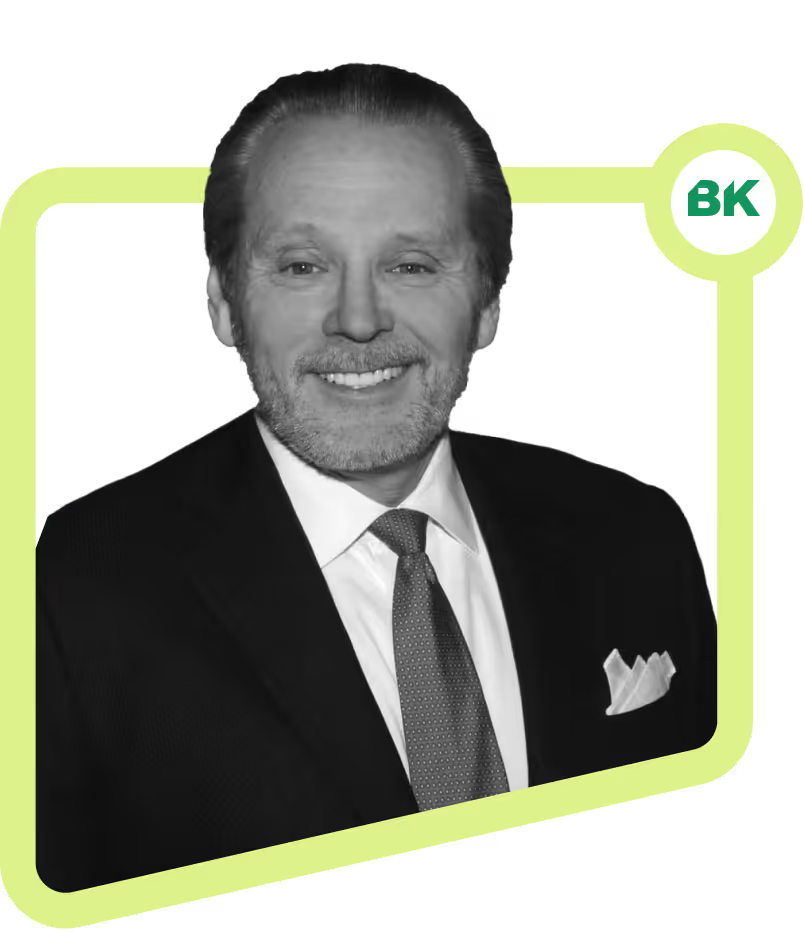
Bob Knakal | Chairman & CEO
bk@bkrea.com | 917.509.9501
Bob Knakal has been a broker in NYC since 1984. Over that time, he has brokered the sale of over 2,425 buildings having a market value of approximately $24.9 billion. The 2,425 properties sold Is generally considered to be the highest total for any individual broker in the history of the United States.
For 26 years of those years (1988-2014), he owned and ran Massey Knakal Realty Services which sold more than 3x the number of properties as the #2 firm in NYC from 2001-2014. Running the firm with a Servant Leadership management style, focusing on empowering everyone on the team, intensely training them and building their self-esteem, led to this overwhelmingly dominant platform. The firm was sold to Cushman & Wakefield in 2014 for $100 million.
The Massey Knakal Legacy is illustrated by the fact that today in the New York City investment sales market, there are 35 companies, or divisions of companies, that are either owned by, or run by, folks who learned the business at Massey Knakal.
Bob is a prominent thought leader in the commercial real estate business, frequently writing about the market, lecturing on the market, and appearing on podcasts and national television shows on networks like Fox, CNBC and MSNBC.