


Buildings Sold

Total Building Sales

Total Square Feet Sold

NYC CRE Market Expertise


Prefer to watch instead of read? Stay tuned for the BKREA video series — short, topic-specific videos breaking down the newsletter’s biggest pieces: construction updates, new deals, legislative changes, and more. Same insight, just a faster format.



Voters approved two charter changes last November that fundamentally rewire land use review across New York City. ELURP compresses the standard seven month ULURP process down to about ninety days, sixty days of concurrent community board and borough president review followed by a thirty day City Planning Commission vote, for qualifying projects that don't trigger environmental review. AHAB creates a three person board, the mayor, the council speaker, and the local borough president, that can override a council rejection of a qualifying affordable project on a two to one vote, effectively ending the era of individual council member deference on these projects.
The rules took effect June 17 and the comment period on the ELURP rulemaking closed September 9. The next major milestone is October 1, when City Planning is required to publish the official list of the twelve community districts citywide with the lowest affordable housing production. Districts that land on that list will get expanded fast track eligibility for larger projects under ELURP, meaning shorter review timelines and a meaningful edge for developers assembling or building in those neighborhoods. For anyone tracking entitlement strategy across the city, that October 1 announcement is worth watching closely.

Sandy Nurse's Community Opportunity to Purchase Act, Intro 0905, gives city approved nonprofits a first look at certain distressed multifamily buildings before they hit the open market. REBNY fought early versions hard, but after Nurse narrowed the covered property pool and shortened the nonprofit purchase window this spring, REBNY's Zach Steinberg told the Council this month the changes are "meaningful" even while pushing for a clean exit path for buildings that no longer qualify and limits on HPD's power to expand the program by rulemaking. Small Property Owners of New York is still dead set against it, nonprofit developers like Habitat for Humanity are fully behind it. Whichever way this lands, it changes the disposition timeline and certainty for a chunk of distressed multifamily stock that would otherwise be straightforward investment sales or assemblage plays.
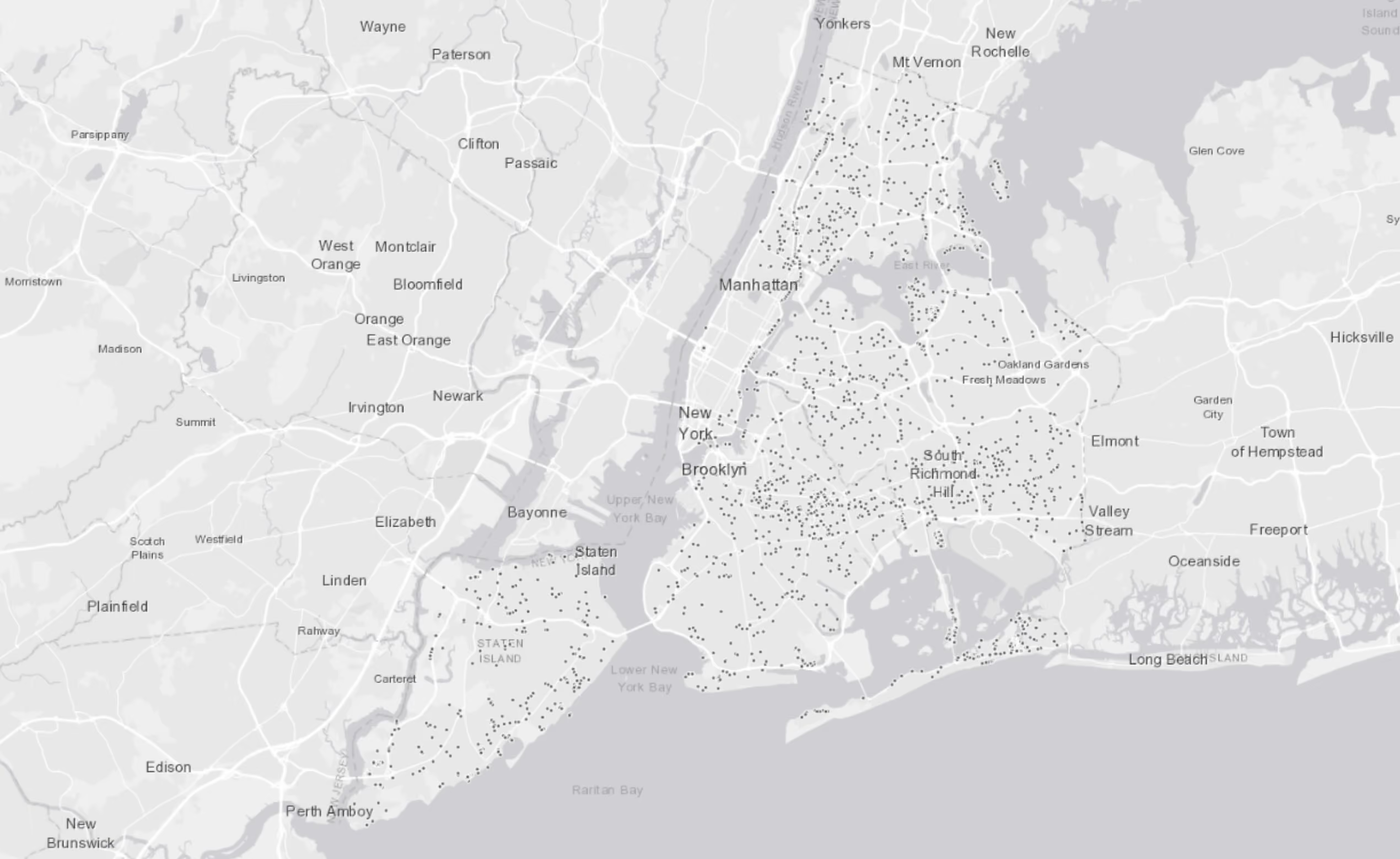
Mayor Mamdani's Land Inventory Fast Track (LIFT) program is a citywide push to identify City owned land that can be turned into housing. It comes out of Executive Order 4, signed on the Mayor's first day in office, and ties into his broader Block by Block housing plan. The City owns or leases more than 15,000 properties, an area roughly the size of Brooklyn, and LIFT is meant to figure out where in that portfolio new homes can realistically get built.
The numbers behind it are worth noting. Over half of City land is parks and cultural resources, about 38% supports active services like schools, hospitals, and firehouses, and just over 2,000 acres are already residential, mostly NYCHA. Less than 2% is truly vacant, and even less of that is usable once you factor in underwater lots, wetlands, and oddly shaped parcels. Still, the City is already moving on more than 100 sites expected to bring roughly 50,000 new homes online, and the administration plans to issue RFPs for five or more new sites every year for the next four years.
The LIFT Tracker itself is the interactive map at the center of the story, showing the pipeline of these housing projects as they get announced and move forward. It draws from the City Owned and Leased Property Database, MapPLUTO, and the Local Law 125 pipeline transparency report, and will keep updating as new projects come online.
On July 16, Mayor Zohran Mamdani released the Rental Ripoff Report, a package of 23 policy actions shaped by testimony from more than 2,400 New Yorkers at hearings held in all five boroughs between February and April. The hearings, established through Executive Order 8 in the Mayor's first week in office, surfaced a familiar list of grievances — pests led all testimony at 16%, followed by mold and leaks at 13% each — and the administration has now translated that feedback into a sweeping enforcement agenda.
For owners, the message is unambiguous: the City intends to use "every tool at its disposal," including executive action, agency rulemaking, legislation, and litigation, with "repeat-offender" landlords squarely in the crosshairs. Among the immediate executive actions, HPD will investigate every heat complaint individually rather than consolidating complaints by building, tenants will be able to schedule certain inspections directly, and the City will move to formally recognize tenant unions — expanding tenants' ability to organize and bargain collectively over building conditions.
The report also reaches into the leasing process itself. Landlords will be required to disclose when rental listings have been altered using artificial intelligence or other digital tools, and fees and utility charges will face tighter oversight.
Perhaps most consequential for the ownership community is the Legislative Task Force the Mayor's Office to Protect Tenants will convene. On its study list: financial penalties under the Underlying Conditions Program for failure to remediate mold, a strengthened Alternative Enforcement Program for chronic violations, digital service of HPD violations, and a long-overdue modernization of the property registration system — which today remains paper-based and doesn't require so much as an email address. Council Member Pierina Sanchez, who chairs Housing and Buildings, flagged J-51 reauthorization as a priority for the task force as well.
The report builds on the administration's Block by Block housing plan, which charts a path to build 200,000 affordable homes and preserve another 200,000. The takeaway for our readers: compliance costs and enforcement exposure are rising, and the regulatory posture toward multifamily ownership in New York has shifted decisively. Owners with open violations — particularly mold, heat, and pest conditions — should expect faster, more granular scrutiny.

Credit: NYC GOV
Tucked into Chapter Two of the Mamdani administration's Block by Block housing plan — under its push to enable new forms of social housing — is a policy every owner and investor trading in New York multifamily should have on their radar: the Community Opportunity to Purchase Act (COPA).
The administration will work with Council Member Sandy Nurse to pass the legislation, which would fundamentally alter the sale process for certain properties. Under COPA, qualified buyers with a proven track record in managing affordable housing would receive an exclusive window to purchase certain properties when they come to market — and, once that window closes, an opportunity to match the terms of any offer the seller receives. The stated aim is to allow qualified organizations to more easily acquire buildings in need of responsible ownership.
The administration frames COPA as an extra layer of protection for tenants of distressed properties, who it says face particular risk of displacement or worsening conditions if their buildings are purchased by speculative buyers.
COPA doesn't stand alone. It's paired in the plan with the SAFER Homes Act, sponsored by Council Member Pierina Sanchez, which would reinvent the Third-Party Transfer program — targeting the city's most distressed buildings where owners have persistently failed to pay property taxes and water bills and have racked up serious Housing Maintenance Code violations, and transferring them to mission-driven owners for rehabilitation and long-term affordability.
For sellers, the practical takeaway: if COPA passes, marketing timelines and deal certainty for covered properties will change. An exclusive first-look period and a match right introduce new sequencing into any disposition — and both buyers and sellers will need to underwrite accordingly.
Released May 2026 by the Mamdani Administration
New York City released what it believes to be its most expansive housing policy plan in modern history, committing over $22 billion over five years. The two core targets are building 200,000 new affordable homes and preserving 200,000 existing homes over the next decade. The backdrop: a 1.4% rental vacancy rate — the lowest in 50 years — with essentially zero vacancies in low-cost units and over 100,000 people in shelters nightly. The plan attempts to span enforcement, preservation, new construction, zoning, homeownership, homelessness, and permitting reform, and has direct implications across the commercial real estate industry — from multifamily ownership and development to debt markets, land, and conversions.
The city has allocated more than $5 billion for affordable housing in FY27–FY28 alone — a 35%+ increase over prior years. HPD will finance roughly 8,000 new affordable units per year near-term, scaling to 21,000+ per year by FY31. 30% will target extremely low-income households (0–30% AMI); 20% will target very low-income households (31–50% AMI). This level of public capital is intended to crowd in private and federal financing, and significantly increases the volume of subsidized deals entering the development pipeline.
The plan pursues citywide transit-oriented development (TOD), neighborhood-scale rezonings, and new high-density zoning districts (including R12, a new high-density category). Starting January 1, 2027, affordable housing projects in the 12 community districts with the lowest recent affordable production will receive a fast-tracked 90-day public review, versus the normal seven-month process. The city's land portfolio (~15,000 properties) has been tasked with yielding at least 25,000 units over 10 years. Major development sites being planned include Sunnyside Yards (100+ acres, 20,000+ units) and Brooklyn Marine Terminal.
The SPEED Task Force produced seven initiatives designed to cut affordable housing development timelines by 8 months across all projects, and by up to 2 years for projects requiring a zoning change. The most significant change: DCP's pre-certification process for zoning actions will be reduced from an average of approximately 2 years to 6 months. The affordable housing lottery (Housing Connect) is being overhauled, with a target of cutting the median approval time from 210 days to under 100 days.
Insurance premiums for affordable and rent-stabilized buildings tripled from roughly $600/unit to $1,800/unit between 2018 and 2025, contributing directly to financial distress across the regulated housing stock. The city is investing $100 million to establish a new city-backed insurance program targeting 20,000 regulated units by 2027 and expanding to 100,000 by 2030. Additional cost relief is being pursued through façade inspection reform (extending baseline cycles from 5 to 6 years), expanded water affordability benefits, J-51 tax abatement extension through 2036, and a reassessment of property tax capitalization rates for majority rent-stabilized buildings — which resulted in an average 1.3% tax reduction for affected buildings in FY27.
The city's new "Fix the City" program will identify and pursue comprehensive enforcement actions against at least 10 of the most distressed landlord portfolios in 2026. Enforcement tools include roof-to-cellar inspections, 7A proceedings (court-ordered management removal), Emergency Repair Program cost recovery, criminal referrals, lender engagement to force compliance or foreclosure, and expedited Housing Court proceedings. The explicit stated outcome is ownership transfer to mission-driven buyers. Separately, heat complaints — 300,000 in 2025 — will now each be investigated as individual cases beginning October 1, 2026.
HPD plans to grow homeownership production by 85% in FY27–FY28 compared to FY24–FY25. New programs include Our Home (conversion of rental buildings to resident-owned cooperatives), a basement apartment legalization pilot (15 Community Districts initially), and a manufactured ADU permitting pathway (DOB rules to be promulgated in 2026). The Plus One ADU program provides up to $395,000 in financial support per unit. The Mayor's Office of Deed Theft Prevention was created by executive order in April 2026. HomeFix home repair loan maximums were raised from $60,000 to $100,000 per home, plus $30,000 per additional rental unit.
At least 12,000 new residential units are expected from office-to-residential conversions enabled by the "City of Yes for Housing Opportunity" zoning reforms and the State's 467-m tax program. A persistent bottleneck — asbestos plan review through DEP's ATRU unit — is being addressed with a staffing doubling that is estimated to cut review times by 2 months. The conversion pipeline is concentrated in older Class B/C office buildings with full-floor plate sizes and configurations suitable for residential use.
NYCHA houses over 500,000 residents in 177,000 apartments across 335 developments. Its 20-year Physical Needs Assessment is $78 billion, though 2026 marked the first slight decrease in that figure. The city's 5-Year Capital Plan for NYCHA is $5.6 billion — the largest in recent history. About 25% of the portfolio (44,600 units) has been renovated or has a defined path via PACT, the Public Housing Preservation Trust, or Comprehensive Modernization. Some 6,088 units remain vacant, with a $374 million investment targeting turnover. NYCHA is also moving to expand its role as a public developer via Build First redevelopment, Transfer of Assistance pilots, the new SMRRT revolving loan, and sales of development rights.
The Affordable & Efficient Code Reform (AECR) Task Force will convene in late 2026 to review specific NYC Construction Code provisions that add cost without proportionate safety benefit. Primary areas under review include elevator sizing standards (currently requiring larger cabs than comparable European/Asian markets), plumbing material restrictions (plastic pipe prohibition in interior water distribution), and shared/SRO housing legalization. Industrialized and modular construction is being actively promoted, with EDC investing in workforce development, site identification for manufacturing facilities, and IDA incentives. The Construction Justice Act (Local Law 21 of 2026) establishes a $40/hour combined wage and benefits floor for all workers on city-assisted housing projects.
Two pieces of legislation with significant market implications are being pursued. The SAFER Homes Act revamps the Third-Party Transfer (TPT) program — a mechanism by which the city can take title to distressed properties and transfer them to mission-driven owners. It focuses on buildings with accumulated unpaid municipal charges (taxes, water bills) and serious Housing Maintenance Code violations, with provisions protecting existing homeowner equity and creating pathways to resident ownership. The Community Opportunity to Purchase Act (COPA) would give pre-qualified affordable housing operators an exclusive window to purchase properties when listed, plus a right to match any third-party offer once that window closes.


.png)
The recently enacted pied-à-terre tax may ultimately prove to be one of the most disruptive pieces of real estate legislation New York state has passed in years. Whether one agrees with the objective or not, the manner in which it was enacted and the uncertainty it introduces into the marketplace are likely to create consequences far beyond the revenue the tax is expected to generate.
At a high level, the law imposes a new tax on certain New York City residential properties that are not used as the owner's primary residence. During the initial phase of the legislation, condominiums and cooperative apartments valued at more than $1 million may be subject to significant annual taxes, while single-family homes become subject to the tax beginning at a $5 million valuation threshold.
The legislation then contemplates a second phase beginning in 2028 that would utilize a different valuation methodology and substantially reduce the effective tax burden on many affected properties. Whether that second phase is actually implemented as written remains an open question.
What is not an open question is that uncertainty has now been injected into the market.
As I have said for 17 years in this column, markets dislike uncertainty. Buyers dislike uncertainty. Lenders dislike uncertainty. Developers dislike uncertainty. Investors dislike uncertainty. Whenever participants in a market become uncertain about future costs, future regulations, future tax obligations or future values, many simply postpone decisions until they gain greater clarity. That hesitation alone can slow transaction activity.
I believe that is exactly what we are about to see in the luxury condominium and cooperative market.
The legislation creates questions about valuation methodologies, ownership structures, trusts, LLCs, enforcement procedures, appeals processes, cooperative board responsibilities and constitutional challenges. Litigation appears almost inevitable. Buyers considering a purchase today may understandably decide to wait until they have a better understanding of how the law will be interpreted, challenged, enforced and potentially modified. Sellers may find buyers becoming more cautious. Transaction velocity may slow. Values may come under pressure.
None of that should be surprising.
What is interesting, however, is that I do not believe the same conclusion necessarily applies to development land.
At first glance, one might assume that a tax designed to impact luxury residential ownership would immediately damage development site values. I am not sure that is the case. The reason is timing.
Developers who are bringing condominium projects to market over the next two years have already made their investment decisions. In many cases, they purchased their land two, three, four or even five years ago. They underwrote those acquisitions without anticipating this legislation. They have already committed their capital, secured financing, navigated approvals, and undertaken construction. They are now preparing to sell units into a market that suddenly faces a new tax regime and substantial uncertainty.
Those developers may very well be the biggest casualties of this legislation. The developer purchasing land today, however, is in an entirely different position.
A land buyer closing on a development site in 2026 is typically underwriting a project that will not be completed until 2029, 2030 or beyond. By the time those units reach the market, the current phase of the pied-à-terre tax will have ended. The law itself contemplates a transition to a significantly different framework beginning in 2028. There will almost certainly be legal challenges. There may be amendments. There may be political changes. There may be implementation delays. There may even be a complete restructuring of the legislation.
In other words, today's land buyer is not underwriting today's residential market. They are underwriting the residential market that will exist several years from now. That distinction is critically important.
If the law unfolds as currently written, many of the concerns affecting condominium sales over the next 18 months may no longer exist by the time projects being acquired today are delivered. While existing condominium inventory may experience near-term headwinds, development land values should be influenced far more by future conditions than current conditions.
There is, however, one very important caveat.
If the state legislature ultimately extends the current high tax rates beyond 2028, delays the transition to the second phase, or otherwise converts what appears to be a temporary burden into a permanent one, the equation changes dramatically. At that point, developers would have to underwrite future residential values using a very different set of assumptions. If future condominium values are permanently impaired, development land values will eventually be affected as well.
But that is not the world we are operating in today.
Today, the market appears to be confronting a two-year period of uncertainty. That uncertainty may hurt luxury condominium sales. It may hurt cooperative sales. It may create litigation. It may create confusion. It may reduce transaction volume. It may frustrate owners and buyers alike. Just like the state capital gains tax in the 1990s ended up producing less revenue than before the tax was implemented, this tax may turn out to have the same impact.
What it should not do, at least for now, is materially alter the value of development land being acquired today.
Ironically, the developers most likely to be hurt by this legislation are not the ones making acquisitions now. They are the ones who made acquisitions years ago. They have already placed their bets and are now approaching the finish line just as the rules of the game are changing.
That is rarely good public policy. Then again, when does common sense impact public policy?
New York City may be on the verge of unlocking a largely overlooked category of housing supply. The City Council recently announced proposed reforms to the City's Construction Codes aimed at making it easier to build on small, underutilized lots across the five boroughs — parcels that have long sat idle due to outdated regulations that made residential development impractical or financially unworkable.
Council Speaker Julie Menin has described these lots as having "the potential to deliver tens of thousands of new homes, but outdated rules and unnecessary red tape are standing in the way." The proposal projects that reforms could enable the creation of as many as 35,000 new housing units across nearly 3,000 small lots, all without requiring new zoning changes.
The targeted lots are generally between 15 and 27 feet wide, a scale that has historically been caught in a regulatory gap — too small for high-rise economics, but constrained by safety standards that made mid-rise construction equally difficult. The proposed framework would create new as-of-right development pathways for buildings up to eight stories, while also reducing construction costs and streamlining approval timelines by eliminating certain technical barriers that have caused delays.
What makes this proposal particularly notable is its timing. As of March 2026, the City's housing vacancy rate sits at just 1.88%, with median rents reaching $5,000, and active listings have been declining for nearly two years. Against that backdrop, any mechanism that can add meaningful supply without lengthy rezoning battles carries real weight.
To guide implementation, the Council has established a new Advisory Group on Housing Affordability, bringing together voices from the nonprofit housing sector, the building trades, and private development. The group is expected to shape how the reforms are drafted and integrated into the City's broader housing strategy.
For property owners and developers, the practical upside is significant. Lots that were previously considered too constrained to pencil out could now become viable mid-rise development opportunities, generating new jobs and tax revenue while converting underused land into much-needed housing. The effectiveness of the reforms will ultimately depend on how safety standards are incorporated into the new framework and how the market responds — but the direction of the Council is clear. Small lots are now firmly part of the housing conversation.
Every two years in New York City, there is an election cycle that most people outside of politics barely notice, but those of us in the real estate business watch very closely: the New York City Council elections. Unlike mayoral races, which tend to dominate headlines and shape broad narratives, City Council elections are far more localized, far more nuanced, and, in many ways, far more impactful on the day-to-day realities of owning, operating, and selling property in this city.
The next Council cycle, culminating in the 2027 elections, is already beginning to take shape. And while it may seem early, the groundwork for those outcomes is being laid right now—through term limits, shifting political coalitions, and the emergence of a new generation of candidates who will ultimately influence land use, zoning, taxation, and the regulatory environment for years to come.
To understand why this matters, you have to start with a simple reality: in New York City, almost every meaningful real estate decision is political before it is economic.
The City Council plays a central role in that dynamic through its control over the Uniform Land Use Review Procedure (ULURP). While the process is often framed as a structured review involving multiple stakeholders, in practice it is heavily influenced by the local Council Member. This long-standing tradition of “member deference” effectively gives each Council Member significant control over rezonings, special permits, and large-scale development projects within their district.
For property owners—particularly those with development or repositioning opportunities—this creates a very specific type of exposure. The value of a property is not just tied to its current income or physical characteristics, but to what a local elected official is willing to support.
And that is where the upcoming elections become so important.
Due to term limits, a meaningful number of current Council Members will not be eligible to run again in 2027. Term limits in New York City are capped at two consecutive four-year terms, which means that many Members first elected in 2021 will be reaching the end of their allowable tenure. This is particularly relevant because the 2021 cycle ushered in a wave of more progressive candidates, many of whom ran on platforms centered around tenant protections, stricter development controls, and increased skepticism toward market-rate housing.
From the perspective of the real estate industry, that cohort has been viewed as, at best, cautious and, at worst, adversarial.
Policies such as support for “Good Cause” eviction, opposition to certain rezonings, and a general preference for downzoning or contextual development have created an environment where the path to new supply has become more constrained. For owners of development sites, that translates directly into uncertainty, longer timelines, higher costs, and, ultimately, lower land values.
At the same time, it is important to recognize that not all incumbents are viewed equally.
There are Council Members who are broadly seen by the real estate community as pragmatic—individuals who understand that housing supply, economic development, and tax revenue generation are interconnected. These Members have generally been more willing to engage in productive dialogue around rezonings, density, and the need for new construction, particularly in areas where infrastructure can support growth.
Others, however, have taken a more rigid approach, often aligning with anti-development constituencies and viewing new construction through a primarily negative lens. In those districts, we have seen projects delayed, scaled back, or abandoned altogether—not because they lacked economic merit, but because they lacked political support.
As we look toward the next election cycle, the key question is whether the composition of the Council will shift in a way that either reinforces or recalibrates that balance.
Several dynamics are worth watching.
First, open seats created by term limits tend to attract a wide range of candidates, often leading to crowded primaries where outcomes can be unpredictable. In many cases, these races are decided by relatively small numbers of highly engaged voters, which can amplify the influence of more ideologically driven groups.
Second, there is an emerging tension within the city’s political landscape between those who prioritize affordability through regulation and those who recognize the need to increase supply as a fundamental solution to the housing crisis. That debate will play out district by district, with significant implications for land use policy.
Third, and perhaps most importantly, there is a growing awareness—even among some traditionally skeptical constituencies—that the current pace of housing production is insufficient. Rising rents, limited availability, and increasing pressure on middle-income households are forcing a reconsideration of policies that may have unintentionally constrained supply.
For the real estate industry, this creates both risk and opportunity.
On the risk side, uncertainty around election outcomes can delay decision-making. Owners considering a sale of a development site or a vacant building may choose to wait, particularly if they believe a more favorable political environment could emerge. Conversely, if there is concern that a district may shift in a less development-friendly direction, that can accelerate decisions to sell before new policies take hold.
On the opportunity side, periods of political transition often create windows where value can be unlocked. New Council Members, particularly those early in their tenure, may be more open to engagement, education, and collaboration. They are forming their views, building their teams, and establishing their approach to land use decisions.
For those willing to invest the time and effort to engage constructively, that can create a meaningful advantage.
Ultimately, the upcoming City Council elections are not just about politics. They are about the future shape of New York City—how much housing gets built, where it gets built, and under what conditions. They will influence everything from the feasibility of development projects to the pricing of land to the willingness of capital to invest in this market.
In a city where government policy and real estate value are so tightly intertwined, ignoring these dynamics is not an option.
The owners who will achieve the best outcomes over the next cycle will be those who understand not just the physical and financial aspects of their properties, but the political landscape in which those properties exist.
Because in New York City, the next buyer is not just underwriting the asset.
They are underwriting the Council Member.
Would continue to apply to 47 of 59 Community Districts
Would apply only in the 12 Community Districts that produce the least affordable housing*
*Only projects subject to the City’s mandatory inclusionary housing policy are eligible for the Fast Track.
The City is proposing two new initiatives aimed at accelerating affordable housing development.
HDFCs developing publicly financed affordable housing could apply directly to the BSA for zoning modifications (use, bulk, parking) without going through ULURP. Approval would require:
Traditional variance requirements, such as proving unique hardship or limiting relief to the minimum necessary, would not apply.
In 12 designated Community Districts, rezoning applications that trigger MIH would be eligible for a significantly streamlined approval process. This would:
The goal is to reduce political friction and shorten timelines for projects that deliver income-restricted housing. This could meaningfully improve execution certainty and speed, particularly in areas that have historically produced limited affordable housing.
The City will evaluate districts every five years (starting in 2026) based on the share of new affordable housing added relative to existing housing stock. The program is designed to target lower-performing districts, primarily lower-density neighborhoods, though some Manhattan areas are included.

Photo Credit: NYC Dept. of City Planning

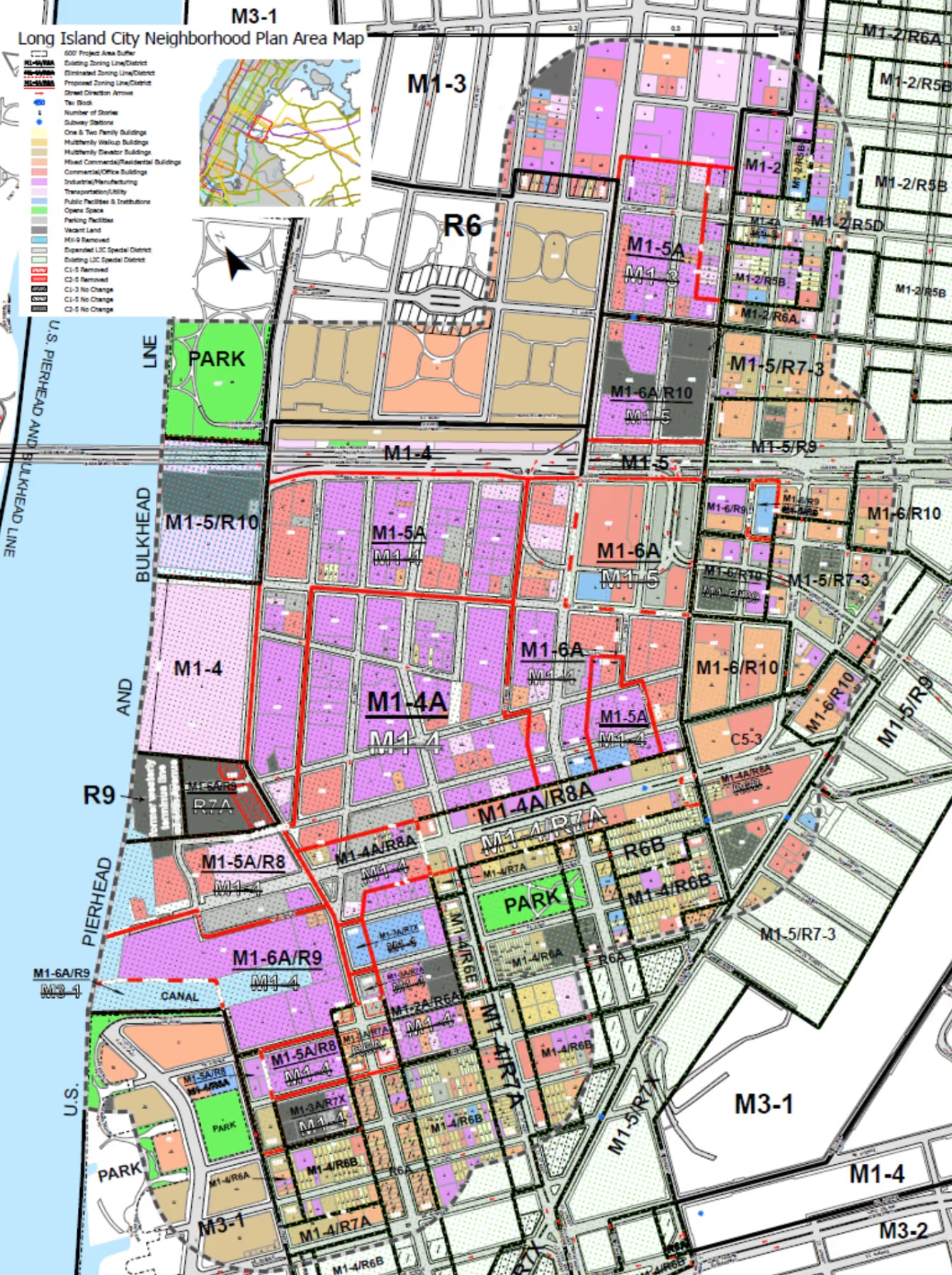


Development Site


Financial District
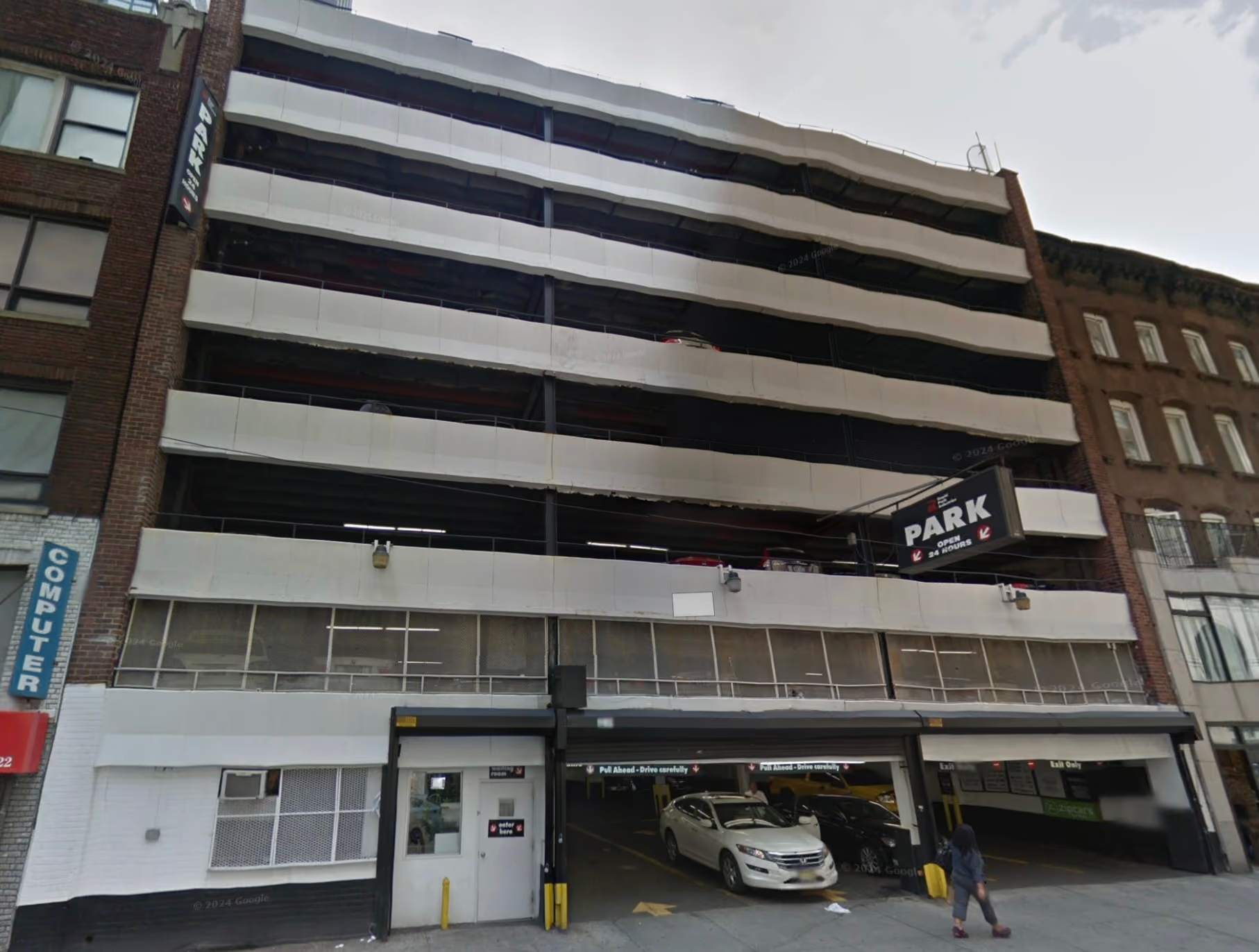
Development Site
NoMad

User / Redevelopment Site
Upper West Side

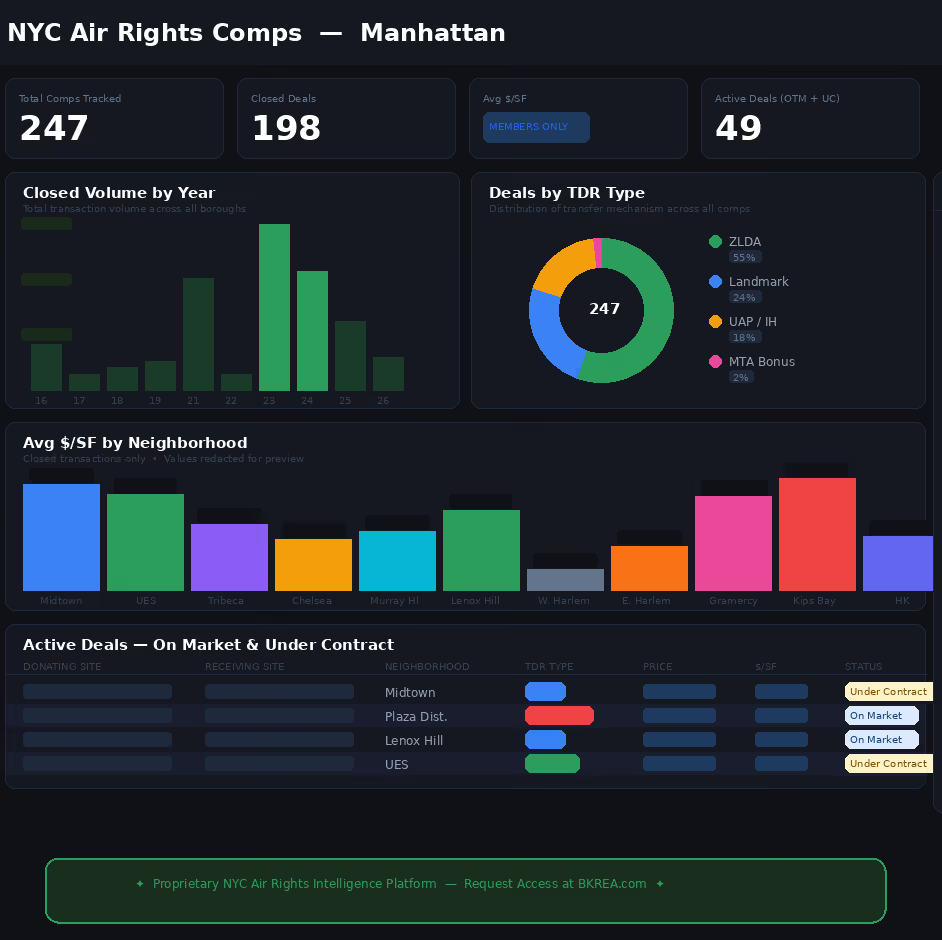
For the first time, BKREA is bringing institutional-grade air rights market data to a single, proprietary platform. The Manhattan Air Rights Intelligence dashboard tracks hundreds of transferable development rights transactions across every submarket in New York City — giving developers and investors instant access to comps, pricing trends, deal structures, and active listings in one place. Filter by neighborhood, TDR type, deal size, price per square foot, and more. Whether you're underwriting a receiving site, valuing a donating parcel, or benchmarking a deal against the market, this is the intelligence layer the air rights market has never had — until now.
The dashboard preview above is for illustrative purposes only. Comp counts, pricing, and data visualizations shown are representative samples. Actual platform data, coverage, and figures will vary. Access is available to select clients upon request.
As artificial intelligence continues to transform commercial real estate, Bob Knakal argues that the competitive value of information is declining while the value of judgment is increasing. Data that once required years of experience and extensive research can now be accessed and analyzed almost instantly. The real differentiator is increasingly what professionals do with that information.
After more than four decades in New York City investment sales and thousands of transactions, Knakal's advantage is not simply access to information. It is the pattern recognition developed by watching decisions play out over time.
He has seen buyers overpay and succeed, sellers reject offers they later regretted, seemingly certain transactions collapse and seemingly impossible deals close. Those experiences create a level of judgment that cannot be replicated simply by providing an AI system with more data.
“AI can shorten the distance between a question and an answer. Judgment shortens the distance between an answer and the right decision.”
The central lesson is that AI does not eliminate expertise. As information becomes increasingly accessible, genuine expertise may become even more valuable because professionals must distinguish between information that is available and information that actually matters.
AI is making property, ownership, transaction and market information faster and easier to access and analyze. This reduces the advantage historically created by simply possessing information.
Judgment incorporates context, experience, motivations, risk, relationships and knowledge of how similar situations have actually played out. It helps determine how much weight to give information and what decision should follow.
The highest bid may come with greater financing risk, limited closing certainty, investment committee requirements or a greater likelihood of retrading. Evaluating the probability of closing can be more important than maximizing the headline offer.
Users may value a property for strategic reasons beyond its investment return. The property may improve their business operations, visibility, location or long-term strategy, creating value that traditional investment metrics do not capture.
As AI makes information increasingly accessible, competitive advantage shifts toward judgment. The ability to interpret information, recognize patterns and make the right decision becomes more important than simply having access to the data.

BKREA reported $833.5 million in transaction volume across 33 transactions through August 2026, representing more than 2.8 million square feet of Manhattan real estate activity. The results highlight continued momentum for the Manhattan-focused investment sales brokerage, particularly across development sites, redevelopment opportunities, and value-add properties.
The firm has accelerated its activity since the beginning of the second half of the year. Since July 1, BKREA has completed nine transactions involving 11 buildings totaling 675,352 square feet and $259.1 million in transaction volume, representing approximately 31% of the firm's total 2026 dollar volume to date.
BKREA's 2026 performance demonstrates continued demand for well-positioned Manhattan investment opportunities despite the evolving commercial real estate environment.
The firm's focus on development sites, redevelopment opportunities, and value-add properties allows it to target assets where sophisticated marketing, proprietary data, and a deep understanding of buyer demand can influence transaction outcomes.
According to Bob Knakal:
“2026 has been a very strong year for BKREA, and the momentum we have seen since July 1 has been especially encouraging.”
Knakal emphasized that the firm's continued execution and focus on development, redevelopment, and value-add opportunities are resonating with owners and buyers.
The 2026 year-to-date results include:
BKREA combines Manhattan investment sales expertise with proprietary research tools, including the Knakal Land Index and Knakal Map Room. These resources support the firm's ability to identify opportunities, understand market conditions, and connect owners with qualified investors and developers.
The firm's growing transaction volume reflects the continued importance of specialized market knowledge and targeted execution in Manhattan's investment sales market.
BKREA reported $833.5 million in transaction volume across 33 transactions through August 2026.
The firm has sold 33 buildings totaling approximately 2.84 million square feet through August 2026.
Since July 1, BKREA has completed nine transactions involving 11 buildings totaling $259.1 million and 675,352 square feet.
BKREA specializes in development sites, redevelopment opportunities, and value-add properties throughout Manhattan.
BKREA uses the Knakal Land Index and Knakal Map Room to support proprietary research, market analysis, opportunity identification, and targeted buyer outreach.
The results demonstrate strong transaction momentum for BKREA and continued demand for strategically positioned Manhattan investment and redevelopment opportunities.

BKREA arranged the $31 million sale of 38 West 21st Street, a 12-story office building in Manhattan’s Flatiron District. The transaction highlights a notable shift in Manhattan’s office investment market, where renewed demand for traditional office properties is increasingly competing with office-to-residential conversion strategies.
Located between Fifth Avenue and Avenue of the Americas, the 1908-built property contains approximately 68,808 square feet and is situated within the Ladies’ Mile Historic District. BKREA marketed the property as a potential office-to-residential conversion opportunity, attracting interest from both residential conversion buyers and traditional office investors.
The transaction provides an important snapshot of the changing Manhattan office market. For several months, prospective buyers primarily evaluated the property through the lens of residential conversion. As marketing progressed, however, office investors entered the process and competed aggressively for the asset.
According to Bob Knakal:
“The lesson from it is that the meaty part of the bell curve in terms of office-to-residential conversion is in the rearview mirror at this point.”
The transaction demonstrates how shifting market fundamentals can create new opportunities for sellers. By marketing an asset around multiple potential investment strategies, BKREA was able to attract a broader buyer pool and capitalize on changing investor sentiment.
The property sold for $31 million, or approximately $450 per square foot.
The property is located between Fifth Avenue and Avenue of the Americas in Manhattan’s Flatiron District, within the Ladies’ Mile Historic District.
It is a 12-story office building containing approximately 68,808 square feet.
Yes. BKREA marketed the property as a potential office-to-residential conversion opportunity, but strong demand from office investors ultimately drove the transaction.
Sioni Group acquired the building and plans to renovate it for continued office use.
BKREA’s Bob Knakal, Faraz Cheema, and Ryan Candel represented Jack Vogel Associates in the transaction.
The sale suggests that investor confidence in Manhattan office properties is improving as leasing activity strengthens, vacancy declines, and buyers increasingly return to traditional office investment strategies.
BKREA successfully arranged the $16.5 million sale of 36 East 12th Street, a seven-story commercial property in Greenwich Village, Manhattan. The transaction highlights continued investor demand for well-located Manhattan properties offering existing income and significant office-to-residential conversion and redevelopment potential.
Located on East 12th Street between University Place and Broadway, the property sits on approximately 5,163 square feet of land with 50 feet of frontage. Its Greenwich Village location, flexible zoning, existing income, and long-term redevelopment potential made the property an attractive opportunity for investors seeking both current value and future upside.
The property combined several characteristics that are increasingly attractive to sophisticated Manhattan investors: a highly desirable Greenwich Village location, an existing commercial building, current income, flexible zoning, and the potential for residential conversion or redevelopment.
The transaction demonstrates how identifying multiple paths to future value can make an asset compelling even in a changing commercial real estate environment.
According to Faraz Cheema:
“This transaction reflects the continued demand for well-located Manhattan development opportunities, particularly in neighborhoods where future supply remains extremely limited.”
The property sold for $16.5 million. Traded reports the transaction at approximately $511 per square foot.
The property is located on East 12th Street between University Place and Broadway in Greenwich Village, Manhattan.
It is a seven-story commercial building with approximately 32,241 square feet and existing income, offering potential for conversion and redevelopment.
Its Greenwich Village location, existing income, flexible zoning, and office-to-residential conversion and redevelopment potential created multiple avenues for future value.
Bob Knakal, Faraz Cheema, Ryan Candel, and Brennan Lee of BKREA exclusively represented the seller.
The sale demonstrates continued investor demand for well-located Manhattan properties that combine existing income with flexible redevelopment and repositioning opportunities.
In his latest Commercial Observer article, Bob Knakal, Founder, Chairman & CEO of BK Real Estate Advisors, examines the growing economic challenges facing New York City’s rent-stabilized housing stock. While Article XI can provide significant property-tax relief to distressed buildings, Knakal argues that the program addresses a symptom rather than the underlying problem: operating expenses are rising faster than regulated rental revenue.
Insurance, real estate taxes, water and sewer charges, labor, fuel, repairs, and maintenance costs have all increased significantly, while owners face strict limits on their ability to increase rents. Knakal explains that when expenses consistently grow faster than revenue, the economics of a property eventually become unsustainable.
The article highlights a fundamental principle of real estate: buildings respond to arithmetic.
There are only a few ways to address a persistent gap between revenue and expenses—revenue can increase, expenses can decrease, someone can subsidize the difference, or the property can eventually become economically unsustainable.
Article XI provides an important tool for distressed properties, but Knakal argues that policymakers must also confront the structural issues causing expenses to grow faster than regulated revenue.
According to Knakal:
“Article XI may be good medicine. It may lower the fever... But, if expenses continue compounding faster than revenue, the underlying infection remains.”
The central question is therefore not simply how to rescue distressed buildings, but how to create a regulatory and economic environment in which those buildings can remain financially viable without requiring extraordinary intervention.
Article XI can provide distressed rent-stabilized buildings with valuable financial breathing room. But long-term stability requires more than lowering one expense.
For New York City’s rent-stabilized housing market to remain sustainable, policymakers must address the fundamental relationship between revenue, operating expenses, regulation, and investment. As Knakal emphasizes, tax relief may lower the fever, but it does not necessarily cure the underlying infection.
Article XI is a New York City property-tax incentive program that can provide qualifying buildings with substantial tax benefits, replacing conventional property taxes with a lower payment in lieu of taxes (PILOT).
For distressed properties, reducing one of the largest operating expenses can restore positive cash flow and help prevent foreclosure or deterioration.
Operating expenses—including insurance, utilities, labor, maintenance, and taxes—have been rising faster than the revenue owners can generate under rent regulations.
Knakal argues that Article XI can stabilize individual properties but does not necessarily solve the broader structural imbalance between regulated revenue and rising expenses.
Significant tax reductions across thousands of buildings could reduce city tax revenue, potentially shifting the financial burden elsewhere through higher taxes, fees, spending reductions, or borrowing.
New York must look beyond temporary subsidies and address the underlying economics of rent-stabilized housing. As Knakal puts it, “Buildings don’t care about politics. Buildings respond to arithmetic.”
BKREA has announced the $28 million sale of 500 Columbus Avenue, a prominent mixed-use redevelopment opportunity located at the northwest corner of Columbus Avenue and West 84th Street on Manhattan’s Upper West Side. The transaction closed on July 31, 2026, with BKREA exclusively representing the seller throughout the marketing and sale process.
The five-story property contains approximately 35,258 square feet and sits on a 10,217-square-foot lot with approximately 102 feet of frontage along Columbus Avenue and 100 feet along West 84th Street. Located just steps from Central Park, the property combines a long-standing retail component with vacant residential space, creating significant potential for repositioning and long-term value creation.
500 Columbus Avenue presented a rare combination of location, existing income, and redevelopment potential. The property's vacant residential floors created an opportunity to unlock additional value while the ground-floor retail component provided ongoing income. Its Upper West Side location, prominent corner presence, and proximity to Central Park further strengthened its appeal to investors and developers.
According to Jake Hulsh:
“The combination of vacant residential space, stable retail income, and an irreplaceable Upper West Side corner created a compelling value-add opportunity for investors.”
500 Columbus Avenue sold for $28 million, with the transaction closing on July 31, 2026.
The property is located at the northwest corner of Columbus Avenue and West 84th Street on Manhattan’s Upper West Side, just one block from Central Park.
The property's vacant residential floors provide an opportunity for conversion or repositioning, while its existing retail component provides income and its prominent location supports long-term value creation.
BKREA exclusively represented the seller, with Bob Knakal, Jake Hulsh, Ryan Candel, and Nick Tuleu working on the transaction.
BKREA is a New York City commercial real estate brokerage specializing in seller representation for investment sales and development sites, combining market intelligence, property research, valuation expertise, and targeted marketing strategies.

BKREA’s Knassau County Knetworking series continued its momentum on August 11, bringing together more than 100 real estate professionals, business leaders, investors, and dealmakers for its sixth event. Hosted by BKREA at Hendrick’s Tavern in Roslyn, New York, the event featured Bob Knakal, Chairman & CEO of BKREA, alongside Dan Abbondandolo, Executive Director at Cushman & Wakefield.
The evening highlighted the power of relationships and face-to-face connections in commercial real estate. Designed to bring professionals together in an informal setting, Knetworking provides an opportunity to exchange ideas, discuss the market, reconnect with colleagues, and build relationships that can lead to future transactions and partnerships.
The Knassau County Knetworking series combines relationship building, market discussion, and community engagement in an informal setting. By bringing together professionals from across real estate and business, the events create opportunities for conversations that can develop into long-term relationships, partnerships, and transactions.
According to Knakal:
“The best deals and the best opportunities often start with a conversation.”
That philosophy remains at the heart of Knetworking and continues to drive strong participation from professionals throughout the Nassau County business and real estate community.
The sixth event brought together more than 100 attendees for an evening of networking, conversation, and relationship building. Hosted by BKREA and featuring Bob Knakal and Dan Abbondandolo, the event demonstrated the continued strength of the Knetworking community and the importance of creating opportunities for professionals to connect outside traditional industry settings.
It is a networking series created to bring together commercial real estate professionals, investors, business leaders, and dealmakers to build relationships and exchange ideas.
The event was hosted by BKREA at Hendrick’s Tavern in Roslyn, New York, with Bob Knakal and Dan Abbondandolo featured during the evening.
More than 100 real estate professionals, business leaders, investors, and dealmakers attended the August 11 event.
The goal is to create opportunities for professionals to connect, exchange ideas, discuss the market, and build relationships that can lead to future business opportunities.
Commercial real estate is highly relationship-driven. Strong professional networks can create opportunities for transactions, partnerships, referrals, and long-term business relationships.
The series is built around a simple idea: some of the best business opportunities begin by bringing the right people together and starting a conversation.

BKREA has announced the successful sale of 36 East 12th Street in Greenwich Village for $16.5 million. The transaction, which closed on July 1, 2026, involved a seven-story commercial building offering existing income and significant office-to-residential conversion and redevelopment potential in one of Manhattan’s most sought-after neighborhoods.
Located between University Place and Broadway, the property sits on approximately 5,163 square feet of land with 50 feet of frontage along East 12th Street. Flexible zoning allows for residential, commercial, or community facility development, providing the buyer with multiple potential strategies for future use and value creation.
The transaction was exclusively marketed by Bob Knakal, Faraz Cheema, Ryan Candel, and Brennan Lee of BKREA, who represented the seller throughout the sale process. BKREA also advised the sellers on structuring the transaction as a C-Corp share sale to provide additional retained earnings through tax savings.
The sale of 36 East 12th Street demonstrates the continued demand for well-located Manhattan properties where existing commercial assets can be repositioned or converted. In supply-constrained neighborhoods such as Greenwich Village, properties offering flexible zoning, existing income, and future redevelopment potential can attract significant investor interest.
The transaction also illustrates how sophisticated seller representation extends beyond marketing a property. By combining valuation expertise, targeted buyer outreach, market intelligence, and transaction structuring, BKREA helped the sellers identify and execute a strategy designed to maximize value.
According to Faraz Cheema:
"This transaction reflects the continued demand for well-located Manhattan development opportunities, particularly in neighborhoods where future supply remains extremely limited."
36 East 12th Street sold for $16.5 million on July 1, 2026.
The property is located in Greenwich Village on East 12th Street between University Place and Broadway.
The property is a seven-story commercial building with existing income and potential for office-to-residential conversion.
Bob Knakal, Faraz Cheema, Ryan Candel, and Brennan Lee of BKREA exclusively marketed the property and represented the seller.
Its Greenwich Village location, existing income, flexible zoning, and long-term conversion and redevelopment potential made it an attractive investment opportunity.
BKREA advised the sellers to structure the transaction as a C-Corp share sale to receive additional retained earnings through tax savings.
The transaction demonstrates continued demand for well-located Manhattan assets with conversion and redevelopment potential, particularly in neighborhoods where future supply is limited.

BKREA has released the August 2026 edition of its Development Site Monthly, providing developers, investors, property owners, lenders, and commercial real estate professionals with timely intelligence on the forces shaping New York City’s development market. The latest edition examines transaction activity, construction pipelines, interest rates, zoning and legislative developments, air rights, financing conditions, and active development opportunities.
The August edition reflects BKREA’s continued commitment to organizing complex market information into practical intelligence that helps real estate professionals evaluate opportunities and make informed decisions. The publication also highlights $209 million in recently closed transactions and notes that BKREA is currently handling 69 exclusive listings representing more than $3 billion in dollar volume.
New York City development is influenced by a complex combination of land values, zoning, interest rates, construction costs, public policy, financing, and future expectations. The August edition is designed to bring these factors together, helping market participants distinguish short-term events from longer-term trends that could influence land values and development decisions.
According to Bob Knakal, Chairman & CEO of BKREA:
"The development market doesn’t move based on one data point. You have to understand transactions, zoning, policy, capital markets and what developers are actually doing in real time."
Genessy Jaramillo added:
"New York City development is increasingly about understanding what is possible, not simply what exists today."
Explore the August 2026 Development Site Monthly on BKREA.com.
It is BKREA’s monthly publication covering development transactions, policy, financing, air rights, construction activity, and market intelligence across New York City.
The Development Site Monthly is designed for developers, investors, lenders, architects, attorneys, property owners, and other commercial real estate professionals navigating the NYC development market.
The August edition highlights $209 million in July closings, three additional deals under contract, NYC policy and zoning developments, Manhattan’s active development pipeline, air rights, interest rates, construction activity, and financing conditions.
Changes to zoning, housing policy, and regulations can significantly affect development potential, land values, project feasibility, and investment decisions.
BKREA combines transaction experience, property-level research, active development site tracking, and ongoing analysis of the economic and policy forces affecting New York City real estate.
The complete August 2026 Development Site Monthly is available through BKREA’s website and its digital resource.

BKREA has been exclusively retained to arrange the sale of 1601 Bronxdale Avenue, a 7.42-acre industrial and flex property in the Parkchester neighborhood of the Bronx. The institutional-scale asset combines stable in-place cash flow with approximately 2.42 million square feet of long-term redevelopment potential, making it one of the most significant covered land opportunities currently available in New York City.
The property occupies a 323,062-square-foot site with 292 feet of frontage along Bronxdale Avenue and is improved with a 354,309-square-foot, two-story industrial building featuring second-floor office space and an on-site parking deck. The property is leased to a diversified mix of industrial and commercial tenants, providing existing income while offering additional value through leasing vacant industrial space and parking at market rents.
1601 Bronxdale Avenue represents a rare opportunity to acquire an income-producing industrial property while controlling a major future development site. The combination of institutional scale, existing cash flow, flexible industrial space, transit improvements, and substantial residential development potential creates multiple paths for long-term value creation.
The property's location adjacent to the future Metro-North station further strengthens its investment profile, while its proximity to Interstate 95 and the Bronx River Parkway supports continued demand for industrial and logistics uses.
According to Genessy Jaramillo, Managing Director of BKREA:
"Opportunities of this scale simply do not come to market very often."
The offering reflects the growing importance of identifying assets that combine current income with future redevelopment potential, particularly in supply-constrained New York City submarkets.
1601 Bronxdale Avenue is a 7.42-acre industrial and flex property in the Parkchester neighborhood of the Bronx.
The site offers approximately 2.42 million square feet of proposed future development potential across six buildings.
The proposed development program includes approximately 2,200 residential units.
The property is improved with a 354,309-square-foot, two-story industrial building with second-floor office space and an on-site parking deck.
The planned Parkchester/Van Nest station is expected to substantially improve regional connectivity and provide an approximately 21-minute trip to Penn Station.
BKREA has been exclusively retained to market the property. The assignment is being led by Bob Knakal, Seth Samowitz, Genessy Jaramillo, and Christian Sweeney.

500 Columbus Avenue, a five-story property on Manhattan's Upper West Side, has sold for $28 million, highlighting the continued demand for well-located properties with significant value-add and redevelopment potential. The property, located between West 84th and West 85th Streets, was acquired by Brooklyn-based Terra Developers from CKMR Corporation, the entity formerly known as Sloan's Supermarkets.
BKREA represented the seller in the transaction, with Bob Knakal and Jake Hulsh leading the assignment. The sale demonstrates the appeal of strategically located Upper West Side assets that combine existing retail income with significant residential upside.
The 35,300-square-foot property sits on a 10,217-square-foot corner lot and includes a Gristedes supermarket, Park West Laundromat, and a shoe repair shop on the ground floor. Above the retail space are 12 apartments that have reportedly remained vacant for approximately 30 years, presenting a significant opportunity for residential repositioning.
500 Columbus Avenue represents the type of opportunity that can attract sophisticated investors: a well-located asset with established retail occupancy, long-vacant residential units, and potential for additional development.
The transaction also highlights how properties that may appear fully utilized at first glance can contain significant untapped value. In this case, the combination of retail space, vacant residential apartments, and a large corner lot created multiple potential strategies for a new owner.
The property had remained in the same ownership lineage since the 1970s, when it was acquired by an entity of Sloan's Supermarkets. Terra Developers ultimately acquired the building for $28 million, with the transaction financed through a $25 million loan arranged by Newmark.
500 Columbus Avenue is a five-story mixed-use property on Manhattan's Upper West Side, located between West 84th and West 85th Streets.
The property sold for $28 million.
BKREA represented the seller, with Bob Knakal and Jake Hulsh handling the transaction.
The property includes 12 apartments that have reportedly been vacant for approximately 30 years, creating potential for residential conversion, in addition to existing ground-floor retail.
Brooklyn-based Terra Developers acquired the property from CKMR Corporation.
Potential strategies include converting the long-vacant apartments into condominiums and exploring additional development on the property's 10,217-square-foot corner lot, subject to zoning and approvals.
The $28 million transaction demonstrates continued investor demand for well-located Manhattan properties where repositioning, residential conversion, and development potential can create additional value.
After more than four decades in commercial real estate, Bob Knakal reflects on the pivotal decisions that shaped one of the most successful brokerage careers in New York City. Rather than attributing success to countless daily choices, Knakal argues that a handful of defining decisions—made with limited information and considerable uncertainty—had the greatest impact on his career, the growth of Massey Knakal, and the founding of BKREA.
From choosing commercial real estate over investment banking to launching multiple companies and navigating economic downturns, the article demonstrates that long-term success is often determined by judgment, preparation, and the willingness to act when opportunity arises.
Business leaders often search for formulas that guarantee success, but Knakal argues that careers are built differently. Daily habits establish the foundation, while occasional high-impact decisions determine long-term direction.
The article highlights that preparation is what enables individuals to recognize and seize opportunities when they arise. The quality of a decision often depends on the experience and character developed long before the decision itself.
According to Knakal:
"Most of our careers are built quietly, one disciplined day at a time. But, every once in a while, life presents an inflection point."
That philosophy underscores the importance of patience, discipline, and continuous growth, reminding professionals that extraordinary outcomes often begin with a single well-considered decision.
The article explains that while daily discipline builds experience, a handful of major decisions often determine the trajectory of a career or business.
Choosing commercial real estate over investment banking after internships at Coldwell Banker ultimately shaped his professional career.
After being unable to secure financing, Knakal and Paul Massey self-funded the business, creating a firm that would become New York City's leading investment sales brokerage.
Leadership believed maintaining specialization while expanding into new markets would create a stronger competitive advantage than diversifying services.
Following September 11, 2001, the company expanded hiring while many competitors downsized, positioning the firm to benefit from New York City's recovery.
Life-changing decisions rarely come with certainty. Long-term success depends on developing the judgment, experience, and discipline necessary to make the right choices when pivotal moments arise.
Terra Developers has acquired 500 Columbus Avenue, a five-story mixed-use property on Manhattan's Upper West Side, for $28 million. Located at the northwest corner of Columbus Avenue and West 84th Street, just one block from Central Park, the property offers significant residential redevelopment potential in one of Manhattan's most sought-after neighborhoods.
The 35,300-square-foot building features ground-floor retail anchored by a Gristedes supermarket and 12 residential apartments that have remained vacant for approximately 30 years. BKREA's Bob Knakal and Jake Hulsh represented the seller in the transaction.
Properties that combine existing income with redevelopment potential continue to attract experienced investors. With vacant residential units, stable retail occupancy, and the possibility of future expansion, 500 Columbus Avenue represents a compelling opportunity to create long-term value in one of Manhattan's strongest residential markets.
The sale also demonstrates continued confidence in Upper West Side assets that offer both immediate cash flow and future redevelopment optionality.
Terra Developers acquired the property for $28 million.
The building offers 12 long-vacant residential units, stable retail income, and the potential for condominium conversion and future vertical expansion.
500 Columbus Avenue is located on the Upper West Side at the corner of Columbus Avenue and West 84th Street, one block from Central Park.
The residential units can potentially be converted into condominiums, and the site offers additional upside through possible vertical expansion.
BKREA's Bob Knakal and Jake Hulsh represented the seller in the transaction.
The sale demonstrates continued investor demand for prime Manhattan assets that combine stable retail income with substantial residential redevelopment potential.
In his latest Commercial Observer article, Bob Knakal, Chairman & CEO of BKREA, explores what separates elite salespeople from the rest of the field. His answer is simple: the best salespeople operate much like elite athletes, relying on disciplined habits, repetition, preparation, and consistency rather than charisma or natural talent.
Drawing on more than 42 years of experience and more than 2,417 buildings sold throughout New York City, Knakal explains how extraordinary results are built through thousands of ordinary actions. Every prospecting call, owner meeting, property tour, follow-up, and market analysis represents another “deposit” that compounds over time.
The article challenges the traditional perception of sales success. The greatest salespeople are not necessarily the most charismatic or naturally talented. They are the people willing to consistently do the work that others overlook.
According to Knakal:
“You don’t become exceptional by occasionally doing exceptional things. You become exceptional by consistently doing ordinary things extraordinarily well.”
That philosophy applies not only to sales, but also to leadership, athletics, investing, entrepreneurship, and professional development.
Elite athletes train before the competition. Elite salespeople prepare before the closing.
The results that appear extraordinary from the outside are often simply the accumulated product of thousands of ordinary actions performed consistently. Every call, meeting, analysis, follow-up, and lesson becomes another deposit toward future success.
Knakal’s message is straightforward: keep making the deposits, trust the process, and keep pounding the rock.
Both rely on repetition, preparation, discipline, and consistent habits to achieve exceptional results.
Every professional activity—such as prospecting, networking, learning, and following up—acts like a deposit that compounds over time.
Repeated actions build experience, sharpen skills, improve judgment, and increase the likelihood of successful outcomes.
Knakal states that over his 42-year career, he has sold more than 2,417 buildings throughout New York City.
It is the principle that a breakthrough is the result of every effort that came before it. The final blow receives the credit, but the previous blows made it possible.
Extraordinary performance is rarely created by extraordinary individual moments. It is built through ordinary actions repeated consistently and executed exceptionally well.
BKREA has arranged the $35 million sale of 78 Pearl Street and 46 Water Street, a rare block-through development site in Manhattan's Financial District. The transaction represents one of the few remaining large-scale redevelopment opportunities in the neighborhood and highlights continued investor demand for well-located development sites despite a more selective capital markets environment.
The site offers significant redevelopment potential through either a ground-up development or the adaptive reuse and expansion of the existing building. BKREA's Bob Knakal and Ana Barrie represented the seller in marketing the property, leveraging the firm's expertise in New York City development sites.
Large development sites in the Financial District rarely become available. As Lower Manhattan continues to attract residential, hospitality, and mixed-use investment, strategically located redevelopment opportunities have become increasingly valuable.
This transaction demonstrates that experienced developers continue to invest in high-quality Manhattan assets where location, zoning potential, and redevelopment flexibility create long-term value.
Properties: 78 Pearl Street & 46 Water Street
Location: Financial District, Manhattan
Property Type: Block-Through Development Site
Sale Price: $35,000,000
Buyer: Peninim Water LLC (affiliate of Wolfe Landau)
Broker: BKREA – Bob Knakal & Ana Barrie
Potential Uses: Mixed-Use Development, Residential Conversion, Ground-Up Development
The transaction included 78 Pearl Street and 46 Water Street, a block-through development site in Manhattan's Financial District.
The development site sold for $35 million.
BKREA's Bob Knakal and Ana Barrie represented the seller.
Block-through development sites are exceptionally rare in Lower Manhattan and offer greater design flexibility, visibility, and redevelopment potential.
The property was marketed as an opportunity for adaptive reuse and expansion or a new ground-up mixed-use development, subject to applicable zoning and approvals.
The sale reflects continued investor confidence in Manhattan development sites and the long-term growth of the Financial District as a destination for residential and mixed-use development.

Excellence CEO has recognized Bob Knakal, Chairman and CEO of BKREA, for his decades of leadership, innovation, and influence in New York City's commercial real estate industry. The feature highlights how Knakal has built one of the most accomplished careers in investment sales by combining market expertise, disciplined execution, proprietary research, and an unwavering commitment to seller representation.
Having personally brokered more than 2,400 building sales totaling over $24 billion in transaction volume, Knakal continues to shape the future of commercial real estate through BKREA's integration of technology, artificial intelligence, and data-driven advisory services.
The Excellence CEO feature recognizes that sustained success in commercial real estate is built on more than transaction volume. Trust, expertise, innovation, and a commitment to delivering exceptional client outcomes have enabled Bob Knakal to remain one of the industry's most respected advisors.
As the commercial real estate landscape continues to evolve, BKREA demonstrates how combining traditional market knowledge with modern technology creates a stronger, more informed advisory platform for property owners.
According to Bob Knakal:
"The objective is always to achieve the best possible outcome for the client through preparation, market knowledge, and flawless execution."
That philosophy continues to define BKREA's approach to investment sales and reinforces why Knakal remains one of the industry's most trusted commercial real estate advisors.
The publication recognized his long-standing leadership, industry innovation, and record-setting career in New York City commercial real estate.
BKREA combines proprietary market intelligence, artificial intelligence, decades of transaction experience, and seller-only representation to deliver strategic advisory services.
He has specialized in New York City investment sales since 1984, representing property owners exclusively throughout his career.
Representing only sellers eliminates conflicts of interest and allows BKREA to focus entirely on maximizing value and negotiating the best possible outcome for its clients.
BKREA integrates artificial intelligence, proprietary databases, advanced analytics, and market research to improve pricing, marketing, and transaction execution.
Long-term success in commercial real estate is achieved through expertise, preparation, innovation, trusted relationships, and an unwavering commitment to client success.
BKREA has reached a major milestone with its proprietary Knakal Map Room, securing 98 exclusive listing assignments from its first 100 listing presentations using the platform. The 100th presentation resulted in BKREA being retained to exclusively market 161 Tenth Avenue, a premier development site in Manhattan's Chelsea neighborhood.
The achievement reflects a fundamental shift in how BKREA approaches seller representation. Rather than relying on traditional listing presentations focused on brokerage credentials and comparable sales, the Knakal Map Room uses proprietary research, data analytics, and strategic property intelligence to help owners better understand the full potential of their assets before discussing the marketing process.
The Knakal Map Room represents BKREA's transition from a traditional brokerage model to a data-driven advisory platform. By combining decades of market experience with proprietary research systems, the firm helps owners make more informed decisions before properties are brought to market.
The result is a presentation process focused less on promoting the brokerage and more on delivering meaningful value through market intelligence and strategic planning.
According to Bob Knakal:
"The objective isn't to convince owners that we're great brokers. The objective is for owners to leave the meeting thinking, 'They understand my property, my objectives, and my opportunities in ways I hadn't previously considered.'"
That philosophy has helped transform BKREA's listing presentations into strategic advisory sessions, contributing to one of the highest exclusive assignment win rates in the industry.
The Knakal Map Room is BKREA's proprietary research and advisory platform that combines development pipeline tracking, zoning analysis, ownership data, buyer intelligence, historical transactions, and market analytics to create customized property strategies.
BKREA secured 98 exclusive listing assignments from its first 100 listing presentations delivered using the Knakal Map Room methodology.
How is the Knakal Map Room different from a traditional listing presentation?
Rather than focusing on comparable sales and brokerage credentials, the Map Room provides owners with an in-depth strategic assessment of their property and its opportunities before discussing marketing services.
The platform integrates development pipeline tracking, zoning analysis, permit monitoring, buyer intelligence, air rights research, land valuation analytics, neighborhood trends, and historical transaction data.
By helping owners better understand their assets and market opportunities, BKREA positions itself as a strategic advisor rather than simply a brokerage, leading to significantly higher exclusive assignment win rates.
The results suggest that commercial real estate owners increasingly value proprietary research, strategic insight, and customized analysis over traditional sales presentations, signaling a shift toward intelligence-driven advisory services.

Bob Knakal, Chairman and CEO of BKREA, has been recognized by Visionary Titans as the Most Trusted Commercial Real Estate Advisor to Watch in 2026. The recognition highlights more than four decades of leadership in New York City investment sales, along with Knakal's continued efforts to modernize commercial real estate brokerage through data, technology, artificial intelligence, and client-first advisory services.
With a career spanning more than 2,400 building sales and over $24 billion in transaction volume, Knakal has built his reputation on market expertise, proprietary research, disciplined execution, and long-term client relationships. Today, BKREA continues that mission by combining decades of experience with AI-powered market intelligence to help owners maximize asset value.
As commercial real estate continues evolving through technology, artificial intelligence, and changing market conditions, trusted advisors remain essential. The Visionary Titans recognition reflects BKREA's philosophy that technology should enhance—not replace—market expertise, relationships, and disciplined execution.
By combining proprietary information with decades of transaction experience, BKREA continues positioning itself as a strategic advisor for New York City property owners navigating increasingly complex investment decisions.
According to Bob Knakal:
"Superior information leads to superior decisions."
That philosophy continues to shape BKREA's approach to commercial real estate advisory, helping clients maximize value through data, preparation, and strategic execution.
He was recognized for his long-standing leadership in commercial real estate, commitment to client success, innovation in brokerage, and trusted advisory approach.
BKREA combines proprietary market data, artificial intelligence, advanced analytics, and decades of brokerage experience to provide strategic advisory services focused exclusively on seller representation.
Knakal has been selling investment properties in New York City since 1984 and has completed more than 2,400 building sales throughout his career.
Representing only sellers eliminates conflicts of interest and allows BKREA to focus entirely on maximizing value and achieving the best possible outcome for property owners.
BKREA integrates AI with proprietary research and market intelligence to improve pricing analysis, market insights, transaction preparation, and client decision-making while maintaining a relationship-driven advisory model.
Long-term trust is earned through expertise, discipline, innovation, and consistently delivering exceptional results for clients over time.
BKREA has released the July 2026 edition of its Development Newsletter, providing developers, investors, lenders, and property owners with comprehensive market intelligence on New York City's development site market.
Drawing on more than four decades of transaction experience and one of the industry's most comprehensive development site databases, the monthly publication analyzes the trends shaping land values, development activity, financing conditions, zoning policy, and investment opportunities across the five boroughs. The July edition features updates on recent land sales, the Manhattan development pipeline, interest rates, legislative initiatives, and BKREA's proprietary research tools.
As development economics become increasingly influenced by financing costs, policy changes, and market volatility, access to reliable data has become more valuable than ever. BKREA's Development Newsletter brings together proprietary research, transaction experience, and current market intelligence to help developers and investors make informed decisions.
The publication reflects BKREA's commitment to combining information, relationships, and market expertise to better serve owners and investors navigating New York City's complex development landscape.
It is a monthly publication covering development site activity, market trends, financing, zoning, legislative updates, and proprietary research focused on New York City's land market.
The publication is designed for developers, investors, property owners, lenders, brokers, architects, attorneys, and other professionals involved in New York City development.
The July edition emphasizes recent land sales, financing conditions, development pipeline activity, investment opportunities, and the market forces influencing future development decisions.
The Knakal Land Index is BKREA's long-term research initiative analyzing decades of Manhattan development site transactions to identify historical pricing trends and market cycles.
Changes in borrowing costs directly affect land values, project feasibility, acquisition pricing, and development activity, making capital market conditions a critical factor for investors.
BKREA combines decades of transaction experience, proprietary development site data, active market tracking, and specialized research to provide practical insights that support informed investment and development decisions.
Developer Wolfe Landau has expanded his Lower Manhattan development portfolio with the acquisition of a prime Financial District redevelopment site for $35 million.
The transaction includes two adjacent properties at 78 Pearl Street and 46-48 Water Street, creating a block-through development site between Coenties Slip and Hanover Square. The assemblage features a vacant lot along Pearl Street and an existing mixed-use building on Water Street, offering significant redevelopment potential in one of Manhattan's fastest-evolving neighborhoods.
The properties were marketed exclusively by BKREA as a mixed-use development or conversion opportunity, underscoring continued investor demand for well-located repositioning and redevelopment sites in Lower Manhattan.
Redevelopment opportunities in Lower Manhattan remain limited, making assembled sites with flexible zoning and redevelopment potential highly desirable. As office-to-residential conversions, mixed-use projects, and neighborhood revitalization continue throughout the Financial District, investors remain focused on acquiring strategically located assets that can create long-term value.
The transaction also highlights the continued demand for development sites despite evolving market conditions and construction economics.
Properties: 78 Pearl Street & 46-48 Water Street
Location: Financial District, Manhattan
Purchase Price: $35 Million
Site Size: Approximately 10,000 Square Feet
Existing Improvements:
Buyer: Wolfe Landau (Peninim Water)
Seller: Entities affiliated with The Milstein Organization, Swig Company, and Weiler Arnow Management
Broker: BKREA
Developer Wolfe Landau, through an entity affiliated with Peninim Water, acquired the properties.
The combined acquisition totaled $35 million.
The transaction included 78 Pearl Street and 46-48 Water Street in Manhattan's Financial District.
The two properties create a block-through redevelopment opportunity with both vacant land and an existing building that can support future development or repositioning.
BKREA exclusively marketed the assemblage as a mixed-use development or conversion opportunity.
The acquisition demonstrates continued investor confidence in Lower Manhattan redevelopment opportunities and the long-term potential of strategically located development sites.
Artificial intelligence is transforming the way professionals access information, making research, market data, financial analysis, and industry knowledge available in seconds. While this democratization of information levels the playing field, Bob Knakal argues that it also shifts the true source of competitive advantage.
In his latest article, Knakal explains that as information becomes increasingly abundant and inexpensive, judgment—the ability to interpret information, recognize patterns, and make better decisions—becomes more valuable than ever. Experience, curiosity, and continuous learning will separate top performers in the AI era.
According to the article, only three sustainable paths exist:
The article argues that no fourth economic outcome exists.
Artificial intelligence is reshaping nearly every profession by making knowledge more accessible than ever before. As technical information becomes easier to obtain, professionals must develop skills that AI cannot easily replicate—including critical thinking, judgment, adaptability, and sound decision-making.
The article encourages readers to view AI as a tool that enhances productivity while recognizing that human judgment remains essential for interpreting complex situations and creating long-term value.
According to Knakal:
"Information is becoming cheaper every day. Judgment is becoming more valuable every day."
He concludes that professionals who remain curious, continuously learn from experience, and refine their decision-making will become increasingly indispensable in an AI-driven world.
The article argues that as artificial intelligence makes information widely accessible, judgment and decision-making become the most valuable professional skills.
AI platforms can now deliver sophisticated research, analysis, and market information within seconds, making access to information far less exclusive than in the past.
Information provides facts and data. Judgment is the ability to interpret that information, identify what matters most, evaluate risks, and make sound decisions.
While AI can analyze data and generate recommendations, the article argues that it cannot replace the contextual understanding, intuition, and pattern recognition developed through experience.
By consistently reflecting on their decisions, analyzing outcomes, asking thoughtful questions, and learning from both successes and mistakes.
In the AI era, access to information is no longer enough. The professionals who combine curiosity, continuous learning, and strong judgment will create the greatest long-term value and maintain a lasting competitive advantage.
Bob Knakal's 42-year commercial real estate career is rooted in principles he learned long before entering brokerage—on the baseball field. His passion for statistics, discipline, consistency, and incremental improvement shaped a career that has resulted in more than 2,400 building sales totaling over $24 billion in aggregate consideration.
Rather than viewing brokerage as a series of individual transactions, Knakal approaches it like a baseball season: every call, meeting, relationship, and assignment contributes to long-term success. His philosophy of specialization, information mastery, and relentless consistency helped build one of New York City's most successful investment sales firms and continues to guide BKREA today.
The article demonstrates that extraordinary careers are rarely built through dramatic breakthroughs. Instead, lasting success comes from disciplined habits, focused expertise, continuous learning, and a commitment to improving every day.
Knakal's baseball mindset—measuring performance, embracing repetition, and playing the long game—has allowed him to remain one of New York City's leading investment sales brokers across four decades of changing markets.
According to Knakal:
"Generalists get considered. Specialists get selected."
That philosophy continues to shape BKREA's approach to seller representation, market research, development advisory services, and client advocacy.
The article explains how the principles Knakal learned through baseball—including discipline, statistics, consistency, and incremental improvement—became the foundation of his commercial real estate career.
Knakal believes focusing on a specific market and becoming the leading expert creates stronger client outcomes and long-term competitive advantages.
The Territory System assigned brokers to highly specific neighborhoods, allowing them to develop unmatched local market knowledge and ownership intelligence.
BKREA's proprietary databases, including the Knakal Map Room, Knakal Land Index, and Developer Ranking System, provide clients with market intelligence that supports better pricing and investment decisions.
By reducing uncertainty through zoning analysis, development scenarios, entitlement guidance, and market research, BKREA helps generate greater buyer confidence and stronger competition.
Long-term success is achieved through discipline, specialization, preparation, and consistency. Like a Hall of Fame baseball career, exceptional brokerage results are built one relationship, one assignment, and one transaction at a time.

For more than four decades, Bob Knakal has built one of the most accomplished careers in commercial real estate through a philosophy centered on discipline, specialization, and consistent execution. Rather than relying on talent alone, Knakal attributes his success to daily habits, market expertise, and a relentless commitment to continuous improvement.
Having completed more than 2,400 building sales totaling over $24 billion in aggregate consideration, Knakal has demonstrated that long-term success is achieved through preparation, information, and disciplined execution. Today, as Chairman and CEO of BKREA, he continues to apply these principles while leveraging technology, proprietary research, and mentorship to shape the next generation of industry professionals.
Commercial real estate is increasingly competitive, making sustained excellence more difficult than ever. The article demonstrates that while markets, technology, and client expectations evolve, the core principles of success remain remarkably consistent: discipline, differentiation, preparation, and relentless execution.
By combining deep market expertise with continuous learning and disciplined daily habits, professionals can build durable competitive advantages that withstand changing market conditions.
According to Knakal:
"Passion, expertise through specialization, and disciplined execution are the foundation of elite performance."
That philosophy continues to guide BKREA's approach to investment sales, seller representation, research, and professional development.
Long-term success is built through discipline, differentiation, and relentless execution rather than talent alone.
Specialization enables professionals to develop deeper expertise, stronger market knowledge, and greater value for clients than generalists can typically provide.
Discipline creates consistency in prospecting, market research, relationship building, and execution, leading to sustained performance over decades.
BKREA combines seller-only representation, proprietary market intelligence, specialized expertise, and technology-driven research to deliver superior client outcomes.
Knakal believes sharing experience and helping develop future industry leaders is one of the most meaningful ways to create a lasting impact beyond personal achievements.
Elite careers are not built through isolated successes but through thousands of disciplined actions performed consistently over time. Expertise, differentiation, and relentless execution remain timeless competitive advantages.
In his latest Commercial Observer article, Bob Knakal examines the growing financial challenges facing New York City's rent-stabilized housing stock. Rather than framing the issue as a political debate, he argues that the long-term sustainability of rent-regulated housing ultimately depends on basic economics.
The article explores how rising operating expenses—including insurance, labor, utilities, maintenance, and capital repairs—continue to outpace rental income when rents remain frozen. Knakal contends that regardless of ownership structure or ideology, every building must generate enough revenue to cover its costs.
According to the article, only three sustainable paths exist:
The article argues that no fourth economic outcome exists.
New York City's rent-stabilized housing represents one of the nation's largest affordable housing systems. As operating costs continue rising, policymakers, owners, and tenant advocates face difficult decisions about how to preserve affordability while maintaining building quality.
The article encourages readers to evaluate housing policy through both social objectives and economic realities, recognizing that long-term affordability depends on long-term financial sustainability.
According to Knakal:
"Eventually, someone has to write the check."
He concludes that whether costs are covered by tenants, taxpayers, or property owners, the underlying mathematics cannot be avoided. Sustainable housing policy must account for both affordability and the financial realities of operating residential buildings.
The article argues that long-term housing policy must account for economic realities, as buildings require sufficient revenue to cover rising operating and maintenance costs.
Operating expenses—including insurance, labor, utilities, repairs, and maintenance—continue increasing regardless of ownership or rent policy, directly affecting building sustainability.
No. The article explains that while debt-free buildings may remain financially stable longer, they eventually face the same challenge if expenses continue rising while revenues remain unchanged.
According to the article, buildings remain sustainable only if rental income increases, government subsidies cover the gap, or building conditions decline due to inadequate funding.
Postponing repairs and capital improvements can lead to deteriorating building conditions, higher future repair costs, and reduced quality of housing for residents.
Affordable housing requires financially sustainable buildings. Regardless of political viewpoints, long-term housing policy must align social goals with the economic realities of operating and maintaining residential properties.
Sioni Group has acquired 38 West 21st Street, a 12-story office building in Manhattan's Flatiron District, for $31 million, marking another notable investment in New York City's improving office market.
BKREA's Bob Knakal, Faraz Cheema, and Ryan Candel exclusively represented the seller, Jack Vogel Associates, which had owned the property since 1968. While the asset was marketed as a potential office-to-residential conversion opportunity, increasing demand from office investors ultimately drove competitive bidding and resulted in a favorable outcome for the seller.
The sale reflects a meaningful shift in Manhattan's office investment market. After several years in which office-to-residential conversions dominated investor interest, improving leasing fundamentals and declining vacancy rates are encouraging buyers to once again invest in office assets.
The transaction also demonstrates the value of flexible marketing strategies that appeal to multiple investment theses, allowing sellers to capitalize on changing market dynamics.
According to Bob Knakal:
"For four or five months, every single buyer wanted to do a residential conversion, and for the last three weeks of marketing we had five office investors that kept leapfrogging over each other."
The transaction illustrates how improving office fundamentals can quickly reshape investor demand and create stronger pricing opportunities for sellers.
The transaction highlights:
38 West 21st Street, a 12-story office building located in Manhattan's Flatiron District.
The property sold for $31 million.
Sioni Group acquired the property and plans to renovate it as an office building.
Yes. The property was marketed as a potential office-to-residential conversion opportunity, but strong demand from office investors ultimately drove the transaction.
BKREA's Bob Knakal, Faraz Cheema, and Ryan Candel represented Jack Vogel Associates in the sale.
The sale suggests investor confidence in Manhattan's office sector is improving as vacancy rates decline, leasing activity strengthens, and more buyers pursue office investments over residential conversions.
BKREA has successfully arranged the $28 million sale of 81 East 3rd Street, a 13-story residential property in Manhattan's East Village. Chairman and CEO Bob Knakal and Managing Director Ana Barrie exclusively represented the seller in the transaction.
The property consists of approximately 36,047 square feet and features a unique combination of 28 student housing units and 13 free-market apartments totaling approximately 187 beds. Its grandfathered density—nearly double what current zoning permits—made the asset one of the most distinctive residential investment opportunities in Manhattan.
As zoning restrictions limit future residential development throughout Manhattan, existing properties with grandfathered density have become increasingly valuable. Investors continue to pursue assets that combine irreplaceable physical characteristics with prime locations and operational flexibility.
The sale of 81 East 3rd Street demonstrates that scarcity, favorable zoning history, and strong neighborhood fundamentals remain powerful drivers of value in New York City's multifamily investment market.
According to Bob Knakal:
"This transaction highlights the continued demand for unique, irreplaceable residential assets in Manhattan's most supply-constrained neighborhoods."
The transaction highlights:
81 East 3rd Street, a 13-story mixed residential building in Manhattan's East Village.
The property sold for $28 million.
Its grandfathered FAR of approximately 7.5 is nearly double what current zoning permits, making it effectively impossible to replicate today.
The building includes 28 student housing units and 13 free-market apartments.
BKREA Chairman and CEO Bob Knakal and Managing Director Ana Barrie exclusively represented the seller.
The sale reflects continued investor demand for supply-constrained residential assets that combine prime locations, unique zoning characteristics, stable income, and long-term appreciation potential.
The commercial real estate industry is undergoing a fundamental shift in how clients find and select advisors. In his latest article, Bob Knakal argues that expertise alone is no longer enough—professionals must also be discoverable.
After receiving two unsolicited calls from property owners seeking representation for a $15 million air rights sale and a $40–50 million development site, Knakal realized both opportunities had one thing in common: neither came through traditional referrals. Instead, both owners found him through online content and artificial intelligence platforms.
The experience highlights how digital visibility, thought leadership, and AI-driven search are reshaping business development across commercial real estate.
Artificial intelligence is changing how business relationships begin. While referrals and personal relationships remain essential, they are increasingly being complemented by AI-powered search, digital content, and online authority.
Professionals who consistently publish educational content, share market insights, and demonstrate expertise online position themselves to be discovered at the exact moment potential clients need guidance.
According to Knakal:
"The best-known broker often gets the first call."
The article emphasizes that the first call creates the opportunity to demonstrate expertise, build trust, and ultimately win the assignment. In the AI era, visibility has become a critical competitive advantage.
The article argues that expertise alone is no longer enough. Professionals must also ensure their knowledge is visible and discoverable through online content and AI-powered search platforms.
AEO is the practice of creating and organizing content so artificial intelligence platforms can understand, reference, and recommend authoritative information when answering user questions.
Property owners are increasingly using AI and search engines to identify brokers with specialized expertise before making direct contact, shifting how new business opportunities are generated.
Content helps establish credibility, demonstrates expertise, and allows potential clients to evaluate a professional before the first meeting, shortening the trust-building process.
He believes professionals who build recognizable personal brands become easier for clients and AI systems to find, increasing their chances of receiving the first call.
In today's market, the most successful professionals combine expertise, reputation, digital content, technology, and visibility. When clients can easily find and verify your expertise, opportunities increasingly begin finding you.
Hawkins Way Capital has expanded its New York City student housing portfolio with the acquisition of 81 East Third Street in Manhattan's East Village for $28 million.
The 13-story, 36,047-square-foot property contains 45 residential units and is currently utilized as a combination of student housing and market-rate apartments. Approximately two-thirds of the building serves as student housing for the New York Conservatory for Dramatic Arts, making it a strategic addition to Hawkins Way's growing student housing platform.
The transaction closed on June 17, 2026, and follows another significant New York acquisition by Hawkins Way earlier in the month, further demonstrating the firm's commitment to the student housing sector.
Student housing continues to attract institutional and private investors seeking stable occupancy and long-term demand fundamentals. As colleges and universities face increasing housing needs, well-located student housing assets remain a highly sought-after investment category.
For New York City, the transaction demonstrates continued investor confidence in residential and student housing properties despite evolving market conditions and capital markets challenges.
Property: 81 East Third Street
Location: 81 East Third Street
Purchase Price: $28 Million
Building Size: 36,047 Square Feet
Stories: 13
Residential Units: 45
Primary Use: Student Housing and Market-Rate Apartments
Student Housing Tenant: New York Conservatory for Dramatic Arts
Buyer: Hawkins Way Capital
Seller: 81 East 3 Street Realty
Hawkins Way Capital acquired the property for $28 million.
The building is a mixed-use residential asset containing student housing and market-rate apartments.
The building spans approximately 36,047 square feet across 13 stories and contains 45 residential units.
The student housing section is occupied by students attending the New York Conservatory for Dramatic Arts.
BKREA's Bob Knakal and Ana Barrie represented both the buyer and seller.
The transaction strengthens Hawkins Way Capital's growing student housing portfolio and reflects continued investor confidence in the sector's long-term fundamentals.

For more than four decades, Bob Knakal has built one of the most accomplished careers in New York City commercial real estate by embracing a simple but powerful principle: specialization creates competitive advantage.
Rather than trying to know a little about every market, Knakal focused on becoming an expert in specific neighborhoods, property types, and ownership landscapes. That commitment to deep market knowledge, combined with disciplined relationship building and proprietary data collection, helped him become one of the most successful investment sales brokers in New York City history.
Today, as Chairman and CEO of BKREA, Knakal continues to apply the same philosophy while leveraging technology, artificial intelligence, and data analytics to help clients navigate an increasingly complex market.
As commercial real estate becomes increasingly data-driven and competitive, specialization allows professionals to develop unique insights that cannot be easily duplicated. Owners and investors benefit from advisors who possess hyper-local knowledge, proprietary information, and a deep understanding of market dynamics.
Knakal's career demonstrates that while technology continues to evolve, expertise, relationships, and information remain the foundations of long-term success.
According to Knakal:
"Expertise through specialization creates differentiation and durable competitive advantage."
That philosophy has helped shape one of the most successful careers in commercial real estate and continues to influence BKREA's approach today.
The article explores how specialization, market expertise, and focused knowledge helped Bob Knakal build one of the most successful careers in New York City commercial real estate.
The Territory System assigned brokers to specific neighborhoods, allowing them to become experts in ownership, zoning, development activity, and comparable sales within a defined geographic area.
Specialization helps brokers develop deeper market knowledge, stronger relationships, better pricing intelligence, and unique insights that create value for clients.
BKREA combines proprietary data, artificial intelligence, market analytics, and decades of brokerage experience to enhance client service and decision-making.
Data and market intelligence are central to the firm's strategy, helping clients evaluate opportunities, pricing, development potential, and market trends more effectively.
Long-term success is often the result of focused expertise, disciplined execution, strong relationships, and a commitment to becoming the most knowledgeable professional within a specific market segment.

For more than four decades, Bob Knakal has built one of the most accomplished careers in commercial real estate through a combination of disciplined execution, long-term relationship building, and an unwavering commitment to consistency. In a recent feature by Time Iconic, Knakal reflects on the principles that have guided his career, the lessons learned from thousands of transactions, and the mindset required to sustain success over multiple market cycles.
Having personally brokered more than 2,400 building sales totaling over $24 billion in transaction volume, Knakal's career serves as a case study in the power of persistence, specialization, and relationship-driven business development.
Knakal's journey demonstrates that extraordinary accomplishments are rarely the result of a single breakthrough moment. Instead, they emerge from thousands of decisions, countless conversations, disciplined execution, and a commitment to continuous improvement.
His career illustrates how expertise, relationships, and consistency can create lasting competitive advantages in one of the world's most competitive real estate markets.
According to Knakal:
"Consistency beats intensity."
That philosophy continues to shape both his personal approach and the culture of BKREA.
Bob Knakal is the Chairman and CEO of BKREA and one of the most accomplished commercial real estate investment sales brokers in New York City history, with more than 2,400 building sales totaling over $24 billion.
The article highlights how disciplined decision-making, relationship building, consistency, and continuous learning contribute to long-term success.
Strong relationships create trust, generate opportunities, improve market intelligence, and often lead to repeat business and referrals.
He views technology and artificial intelligence as tools that enhance productivity, research, and decision-making while complementing—not replacing—human expertise and relationships.
Discipline creates consistency, improves decision-making, and enables professionals to maintain high performance over long periods of time.
Long-term success is built through consistent execution, strong relationships, continuous learning, and a willingness to adapt while maintaining core principles.
BKREA has released the June 2026 edition of its Development Newsletter, providing developers, investors, property owners, and industry professionals with in-depth analysis of New York City's evolving development site market. The monthly publication delivers actionable market intelligence covering development opportunities, legislative initiatives, construction activity, interest rates, and emerging market trends shaping the future of development across the five boroughs.
The June edition highlights BKREA's continued investment in research and data-driven market analysis, including updates on development pipeline activity, air rights transactions, zoning changes, and the firm's proprietary development site databases designed to help clients make informed decisions in a rapidly changing market.
As development economics become increasingly influenced by interest rates, zoning policy, construction costs, and political considerations, access to timely market intelligence has become essential. BKREA's Development Newsletter serves as a resource for stakeholders seeking a comprehensive understanding of development opportunities and risks across New York City.
According to Bob Knakal:
"Access to quality information has never been more important in New York City real estate."
The newsletter reflects BKREA's commitment to providing market participants with actionable research, data, and insights that support better investment and development decisions.
The June edition covers:
Read the June 2026 BKREA Development Newsletter
It is a monthly publication that provides market intelligence, development site analysis, legislative updates, and research focused on New York City's development market.
The newsletter is intended for developers, investors, property owners, lenders, brokers, and other commercial real estate professionals.
The June edition includes development pipeline updates, interest rates, zoning initiatives, legislative developments, air rights transactions, market comparables, and proprietary research.
The Knakal Land Index is BKREA's long-term analysis of Manhattan development site transactions designed to provide insight into market cycles, land values, and pricing trends.
Changes in zoning regulations and public policy can significantly impact development feasibility, land values, project economics, and future investment opportunities.
BKREA combines proprietary transaction data, active development site tracking, market expertise, and decades of industry experience to provide actionable insights unavailable through traditional market reports.
The New York Knicks delivered one of the most remarkable comebacks in franchise history, overcoming a 29-point deficit to secure a dramatic one-point victory. While most observers focused on the game-winning shot, the real lesson extended far beyond basketball.
In his latest article, Bob Knakal reflects on the comeback through the lens of the Stonecutter's Creed—a philosophy centered on persistence, consistency, and the cumulative impact of small actions. The lesson serves as a powerful reminder that major accomplishments in sports, business, and life are rarely achieved through a single breakthrough moment. Instead, success is built one step, one effort, and one victory at a time.
The article connects one of the most exciting moments in recent sports history to a timeless principle of achievement. Whether building a business, growing a career, closing transactions, or pursuing personal goals, success is rarely defined by a single event. Instead, it is the result of countless actions compounded over time.
According to Knakal:
"People celebrate the crack in the rock. The stonecutter understands that the real story was every swing of the hammer that came before it."
The Knicks' comeback serves as a vivid reminder that extraordinary outcomes are often created through ordinary actions repeated consistently.
The Stonecutter's Creed teaches that major accomplishments are achieved through consistent effort over time. The final breakthrough occurs because of all the work that came before it.
The comeback demonstrated how large challenges are overcome through a series of small victories rather than a single dramatic moment.
Long-term success is built through consistent execution, relationship building, disciplined habits, and incremental progress.
Successful brokers, investors, and owners achieve results through years of market knowledge, networking, prospecting, and transaction experience rather than one defining deal.
Persistence allows individuals and organizations to continue making progress even when results are not immediately visible, ultimately leading to breakthrough outcomes.
Every significant achievement—whether in sports, business, or life—is built one action at a time. Consistent effort compounds, and eventually, the numbers win.

BK Real Estate Advisors (BKREA) has announced the bid deadline for 150 West 85th Street, a rare vacant institutional building located in the heart of Manhattan's Upper West Side.
The six-story property, formerly occupied by Manhattan Country School, represents one of the most unique owner-user and redevelopment opportunities currently available in New York City. Being sold through a federal court-supervised process, the asset offers buyers a rare combination of scale, flexibility, and clean title in one of Manhattan's most supply-constrained neighborhoods.
The offering is being led by Bob Knakal, Chairman and CEO of BKREA, alongside Ryan Candel, Tom Brady, and Ana Barrie.
Institutional-scale vacant buildings rarely become available in Manhattan's most established residential neighborhoods. The combination of vacant possession, flexible zoning, existing institutional infrastructure, and a court-supervised sale process creates a unique opportunity for buyers seeking long-term value creation.
The offering reflects continued demand for specialized properties that can serve educational, community facility, residential, or adaptive reuse purposes in high-barrier-to-entry locations.
According to Bob Knakal:
"Opportunities to acquire a vacant, institutional-scale building in the core of the Upper West Side are extraordinarily rare."
The offering includes:
BK Real Estate Advisors (BKREA) is a New York City-based investment sales brokerage and advisory firm specializing in property sales, development sites, market intelligence, and strategic advisory services. The firm combines deep historical data, technology-enabled marketing, and AI-driven tools to maximize value for property owners.
It is a vacant six-story institutional building located on Manhattan's Upper West Side that is being marketed for sale by BKREA.
The building was formerly occupied by Manhattan Country School and is now being delivered vacant.
The R8B zoning permits residential and community facility uses, including educational institutions, religious organizations, and other institutional occupancies.
The existing school Certificate of Occupancy is a significant advantage because school-use approvals are among the most difficult to obtain in New York City.
The property's combination of vacant possession, scale, Upper West Side location, redevelopment potential, and clean title delivery is exceptionally rare in the Manhattan market.
The assignment is being led by Bob Knakal, Ryan Candel, Tom Brady, and Ana Barrie of BKREA.
Bob Knakal recently shared his perspective on New York's newly enacted Pied-à-Terre Tax, arguing that while the legislation may create significant disruption within the luxury residential market, it should not materially impact development land values in the near term.
The tax imposes new annual taxes on certain New York City residential properties that are not used as a primary residence, creating uncertainty for buyers, sellers, lenders, and investors. While Knakal believes the legislation may slow luxury condominium and cooperative transactions, he contends that development land buyers operate on a much longer timeline and therefore face a different set of considerations.
The article highlights an important distinction between existing residential inventory and future development projects.
While luxury condominium owners and developers nearing project completion may face immediate challenges, development site investors often make decisions based on market conditions expected years into the future. This difference in timing may allow development land values to remain resilient despite short-term disruption in the luxury housing market.
The analysis also serves as a reminder that policy changes can have very different impacts across various segments of the real estate industry.
According to Knakal:
"Markets dislike uncertainty."
That principle remains one of the most important drivers of investment behavior across commercial and residential real estate markets.
Unlike existing condominium inventory, development sites are purchased based on future assumptions regarding construction costs, financing conditions, residential demand, and projected sale values.
As a result, current land buyers are evaluating what New York City's residential market may look like years from now rather than reacting solely to today's policy environment.
The legislation imposes additional taxes on certain New York City residential properties that are not used as a primary residence, primarily affecting higher-value condominiums, cooperative apartments, and certain luxury homes.
The law creates uncertainty surrounding future ownership costs, valuation methods, enforcement procedures, and potential legal challenges, all of which may cause buyers to delay purchasing decisions.
Developers purchasing land today are generally underwriting projects that will not be completed for several years, meaning their investment decisions are based on future market conditions rather than current uncertainty.
Developers currently completing condominium projects may face the greatest risk because they made acquisition and construction decisions before the tax was enacted and must now sell into a changed marketplace.
Yes. If the current tax structure becomes permanent or future residential values are materially impaired over the long term, development land pricing could eventually come under pressure as developers adjust their underwriting assumptions.
While the Pied-à-Terre Tax may create near-term disruption for luxury residential transactions, current development land values should remain largely tied to long-term market fundamentals and future residential demand rather than immediate market uncertainty.
BK Real Estate Advisors (BKREA) has announced the launch of the BKREA Air Rights Comparable Sales Database, a proprietary intelligence platform designed to bring greater transparency, valuation accuracy, and market intelligence to New York City's growing air rights and transferable development rights (TDR) market.
The database represents the latest expansion of BKREA's technology-driven advisory platform and provides property owners, developers, investors, and brokers with access to historical air rights transaction data, pricing trends, and comparable sales information that has traditionally been difficult to obtain. The initiative further strengthens BKREA's position as a leader in data-driven commercial real estate advisory services.
As development economics become increasingly complex, access to reliable air rights transaction data can significantly impact valuation, acquisition strategy, development feasibility, and negotiation outcomes.
By centralizing comparable sales information and market intelligence, BKREA aims to help market participants make more informed decisions while increasing efficiency and transparency within the air rights marketplace.
The database launch highlights:
It is a proprietary database designed to track and analyze air rights and transferable development rights transactions, providing users with access to comparable sales data and market intelligence.
Air rights allow property owners to transfer unused development potential to eligible receiving sites, creating value for both sellers and developers seeking additional density.
Property owners, developers, investors, lenders, attorneys, architects, land-use consultants, and brokers involved in development and air rights transactions.
By providing access to historical transaction data, pricing trends, and comparable sales information, users can better evaluate valuations, negotiate transactions, and assess development opportunities.
BKREA operates a specialized air rights marketplace and advisory platform focused on maximizing value for owners and facilitating transferable development rights transactions throughout New York City.
The database is part of BKREA's continued investment in proprietary market intelligence, analytics, AI-powered tools, and research platforms designed to deliver superior advisory services and client outcomes.
Knakal explores one of the most important drivers of long-term success: persistence. Using the classic "Stonecutter's Creed" analogy, Knakal explains how meaningful achievements in business, real estate, and life are rarely the result of a single breakthrough moment. Instead, they are the cumulative result of consistent effort applied over long periods of time.
Drawing from more than four decades in commercial real estate and over 2,400 building sales, Knakal reflects on the role that discipline, repetition, and patience have played throughout his career and offers practical lessons for professionals seeking sustainable success.
In a world focused on instant results and overnight success stories, the article serves as a reminder that sustainable achievement is built through patience, discipline, and long-term commitment. Whether in brokerage, investing, entrepreneurship, or personal development, the same principle applies: success is often the cumulative result of countless small actions performed consistently over time.
According to Knakal:
"Progress is often invisible before it becomes undeniable."
That lesson continues to resonate with business leaders, investors, brokers, and professionals who understand that extraordinary results are usually built through ordinary actions repeated consistently.
It is an analogy illustrating that success often results from many repeated efforts rather than a single breakthrough moment.
The article argues that persistence and consistency are among the most powerful competitive advantages in business and life.
He reflects on his career, explaining how years of prospecting, market research, relationship building, and disciplined execution ultimately led to long-term success.
Many individuals mistake a lack of visible progress for a lack of actual progress and stop before their efforts have time to produce results.
No. Knakal emphasizes that persistence must be paired with the right strategy, activities, and process in order to create meaningful outcomes.
By focusing on consistent execution, maintaining discipline, trusting proven processes, and understanding that meaningful success often requires patience and long-term commitment.

Bob Knakal, Chairman and CEO of BK Real Estate Advisors (BKREA), has been recognized as one of "The Most Visionary Business Leaders to Watch in 2026." The feature highlights Knakal's four-decade career in commercial real estate, his commitment to innovation, and his ability to combine traditional relationship-driven brokerage with cutting-edge technology and data intelligence.
Having personally brokered more than 2,400 building sales totaling over $24 billion in transaction volume, Knakal has built a reputation as one of the most trusted and influential figures in New York City investment sales. His leadership continues to shape the future of brokerage through mentorship, proprietary market intelligence, and AI-powered innovation at BKREA.
As industries continue to navigate rapid technological change, economic uncertainty, and evolving business models, leaders who successfully combine experience with innovation are becoming increasingly valuable. The recognition reflects Knakal's ability to balance traditional relationship-building with modern technology and market intelligence.
His career serves as an example that visionary leadership is not simply about predicting the future—it is about continuously learning, adapting, and creating value for others while maintaining core principles.
According to the feature:
"Trust grounded in results. Vision informed by data and experience."
These qualities continue to position Knakal as one of the most respected leaders in commercial real estate.
The recognition highlights his sustained success, innovative leadership, commitment to mentorship, and ability to integrate technology and data into commercial real estate advisory services.
BKREA is a New York City-based commercial real estate brokerage founded by Bob Knakal that combines proprietary market intelligence, technology, and brokerage expertise to advise property owners and investors.
Trust, consistency, discipline, specialization, mentorship, and continuous innovation are recurring themes throughout his leadership philosophy.
He helped pioneer territorial specialization, developed numerous industry leaders, and continues to advance brokerage through technology and data-driven decision making.
BKREA leverages proprietary databases, artificial intelligence, and advanced analytics to improve market intelligence, client service, and transaction execution.
Sustainable success is achieved through consistent execution, strong relationships, continuous learning, and the ability to adapt while remaining committed to core values.

Bob Knakal, Chairman and CEO of BK Real Estate Advisors (BKREA), has been recognized by The Global Success Review as one of the Most Influential Real Estate Leaders in New York to Watch in 2026.
The recognition highlights Knakal's extraordinary impact on New York City's commercial real estate market, where he has completed more than 2,400 building sales totaling over $24 billion in transaction volume throughout his career. It also underscores his continued leadership in combining market intelligence, technology, data analytics, and client-focused advisory services to shape the future of investment sales brokerage.
As commercial real estate continues to evolve, industry leaders are increasingly measured not only by transaction volume but by their ability to adapt, innovate, and create value for clients.
The Global Success Review's recognition reflects Knakal's ability to bridge decades of brokerage experience with forward-looking technology and market intelligence, positioning BKREA at the forefront of modern commercial real estate advisory services.
According to the themes highlighted throughout Knakal's career:
Success is built through discipline, specialization, innovation, and long-term relationships.
The recognition reflects his record-setting transaction history, industry innovation, leadership at BKREA, and continued influence on the future of commercial real estate brokerage.
Bob Knakal is the Chairman and CEO of BKREA and one of the most accomplished commercial real estate investment sales brokers in U.S. history, with more than 2,400 building sales totaling over $24 billion in transaction volume.
BKREA is a New York City-based investment sales and advisory firm that combines brokerage expertise, proprietary market intelligence, artificial intelligence, and strategic advisory services.
The firm utilizes AI-powered research, advanced analytics, proprietary databases, and market intelligence tools to provide clients with deeper insights and more informed decision-making capabilities.
His approach combines specialization, data-driven decision-making, market expertise, mentorship, and long-term client relationships to create consistent results across changing market conditions.
It highlights the growing importance of combining traditional brokerage expertise with technology, analytics, and strategic advisory services to deliver better outcomes for clients.

Bob Knakal, Chairman and CEO of BK Real Estate Advisors (BKREA), has been featured in The Quiet Reinvention of Real Estate, a profile highlighting how he is reshaping commercial real estate brokerage through data, technology, market intelligence, and disciplined execution.
After more than four decades in the New York City investment sales market and over 2,400 building sales totaling more than $24 billion in transaction volume, Knakal continues to evolve his approach to brokerage by combining traditional relationship-driven advisory services with artificial intelligence, proprietary research, and advanced analytics.
The article examines how BKREA is building a modern advisory platform designed to help property owners make more informed decisions in an increasingly complex market environment.
As the industry undergoes significant transformation, the article highlights a central theme of Knakal's career: the ability to adapt without abandoning core principles.
The profile illustrates how successful brokerage firms can combine market expertise, proprietary information, technology, and client-focused execution to create long-term value.
According to the article's central message, true reinvention is not about abandoning what works—it's about continuously improving how value is delivered.
The article examines how Bob Knakal is helping modernize commercial real estate brokerage through technology, data analytics, artificial intelligence, and strategic advisory services.
Bob Knakal is the Chairman and CEO of BKREA and one of the most accomplished commercial real estate investment sales brokers in U.S. history, with more than 2,400 building sales totaling over $24 billion in transaction volume.
BKREA leverages proprietary data, advanced analytics, artificial intelligence, and market intelligence tools to provide clients with deeper insights and more informed decision-making capabilities.
The firm combines traditional brokerage expertise with technology-enabled advisory services, helping clients evaluate market opportunities, pricing strategies, development potential, and long-term investment decisions.
Accurate market intelligence and transaction data help owners and investors make better decisions regarding acquisitions, dispositions, development opportunities, valuation, and market timing.
BKREA continues to focus on expanding its market intelligence capabilities, leveraging AI to improve client outcomes, and building one of the industry's most trusted investment sales advisory platforms.
BKREA Chairman and CEO Bob Knakal recently shared his perspective on New York City's housing crisis and Mayor Zohran Mamdani's proposed housing plan. Drawing on more than four decades of experience in New York City investment sales, Knakal argues that housing policy must be grounded in economic reality if the city hopes to preserve existing housing stock and meaningfully increase supply.
The article examines the challenges facing rent-stabilized housing, the consequences of limiting reinvestment incentives, the shortcomings of current development programs, and practical solutions that could accelerate housing production while improving affordability over the long term.
As New York City continues to grapple with affordability challenges, policymakers face difficult decisions regarding housing preservation and new development. Knakal's analysis emphasizes that successful housing policy must balance affordability goals with economic incentives that encourage private investment and long-term housing production.
According to Knakal:
"Housing policy cannot be driven solely by politics. It must also be driven by economics."
The article provides a market-based perspective on how New York City can preserve existing housing, stimulate development, and address affordability through increased supply rather than restrictive regulation.
Bob Knakal argues that housing policy must be based on economic realities and investment incentives rather than regulations alone if New York City hopes to preserve and expand its housing supply.
These programs provide incentives for property owners to invest in building improvements and apartment renovations, helping maintain housing quality and preserve existing housing stock.
The article highlights how rising expenses and limited revenue growth can make it increasingly difficult for owners to fund necessary building repairs and capital improvements.
Knakal suggests that large-scale redevelopment of underutilized NYCHA properties could create hundreds of thousands of new housing units while modernizing aging public housing assets.
The article emphasizes that increasing housing supply through development incentives, zoning flexibility, and redevelopment opportunities is the most effective long-term method for reducing pressure on rents.
Bob Knakal, Chairman and CEO of BKREA, believes the recovery in New York City’s Class B and C office market is already underway — and that many investors may be underestimating how quickly the rebound is progressing.
After years of negative sentiment surrounding aging office product, rising vacancies, remote work disruption, and collapsing pricing, Knakal argues that the market has quietly passed its bottom. According to him, improving leasing activity, shrinking office inventory, and the success of office-to-residential conversion programs are fundamentally reshaping Manhattan’s office landscape.
Drawing from decades of experience navigating multiple real estate cycles, Knakal explains why investors waiting for “certainty” may already be missing the most attractive buying opportunities in New York City office assets.
The recovery of New York City’s Class B and C office market could create one of the most important investment shifts in commercial real estate over the next several years.
For years, distressed sentiment dominated the sector. However, the combination of supply reduction, improving leasing fundamentals, and lower basis pricing is beginning to attract sophisticated capital back into the market.
According to Knakal:
“You never know you are at the bottom of the market until you are past it.”
That philosophy reflects a broader theme repeated throughout real estate cycles: the best opportunities often emerge when uncertainty and fear are still elevated.
According to Bob Knakal, the recovery is being driven by shrinking office supply, improving leasing activity, office-to-residential conversions, and significant repricing of older office assets.
The 467m program is an incentive initiative encouraging office-to-residential conversions across New York City, helping remove obsolete office inventory from the market.
Knakal estimates that more than 80 office buildings representing approximately 26 million square feet are actively pursuing residential conversion in Manhattan.
Many investors believe pricing already experienced its sharp correction, while improving market fundamentals are creating more attractive risk-reward opportunities.
No. Knakal notes that well-located buildings with repositioning, leasing, or conversion potential are attracting the strongest investor interest, while weaker commodity office assets may continue facing challenges.
BKREA is a New York City-based commercial real estate brokerage specializing in investment sales, development sites, office properties, and seller representation.
The recently enacted pied-à-terre tax may ultimately prove to be one of the most disruptive pieces of real estate legislation New York state has passed in years. Whether one agrees with the objective or not, the manner in which it was enacted and the uncertainty it introduces into the marketplace are likely to create consequences far beyond the revenue the tax is expected to generate.
At a high level, the law imposes a new tax on certain New York City residential properties that are not used as the owner’s primary residence. During the initial phase of the legislation, condominiums and cooperative apartments valued at more than $1 million may be subject to significant annual taxes, while single-family homes become subject to the tax beginning at a $5 million valuation threshold.
The legislation then contemplates a second phase beginning in 2028 that would utilize a different valuation methodology and substantially reduce the effective tax burden on many affected properties. Whether that second phase is actually implemented as written remains an open question.
What is not an open question is that uncertainty has now been injected into the market.
As I have said for 17 years in this column, markets dislike uncertainty. Buyers dislike uncertainty. Lenders dislike uncertainty. Developers dislike uncertainty. Investors dislike uncertainty. Whenever participants in a market become uncertain about future costs, future regulations, future tax obligations or future values, many simply postpone decisions until they gain greater clarity. That hesitation alone can slow transaction activity.
I believe that is exactly what we are about to see in the luxury condominium and cooperative market.
The legislation creates questions about valuation methodologies, ownership structures, trusts, LLCs, enforcement procedures, appeals processes, cooperative board responsibilities and constitutional challenges. Litigation appears almost inevitable. Buyers considering a purchase today may understandably decide to wait until they have a better understanding of how the law will be interpreted, challenged, enforced and potentially modified. Sellers may find buyers becoming more cautious. Transaction velocity may slow. Values may come under pressure.
None of that should be surprising.
What is interesting, however, is that I do not believe the same conclusion necessarily applies to development land.
At first glance, one might assume that a tax designed to impact luxury residential ownership would immediately damage development site values. I am not sure that is the case. The reason is timing.
Developers who are bringing condominium projects to market over the next two years have already made their investment decisions. In many cases, they purchased their land two, three, four or even five years ago. They underwrote those acquisitions without anticipating this legislation. They have already committed their capital, secured financing, navigated approvals, and undertaken construction. They are now preparing to sell units into a market that suddenly faces a new tax regime and substantial uncertainty.
Those developers may very well be the biggest casualties of this legislation. The developer purchasing land today, however, is in an entirely different position.
A land buyer closing on a development site in 2026 is typically underwriting a project that will not be completed until 2029, 2030 or beyond. By the time those units reach the market, the current phase of the pied-à-terre tax will have ended. The law itself contemplates a transition to a significantly different framework beginning in 2028. There will almost certainly be legal challenges. There may be amendments. There may be political changes. There may be implementation delays. There may even be a complete restructuring of the legislation.
In other words, today’s land buyer is not underwriting today’s residential market. They are underwriting the residential market that will exist several years from now. That distinction is critically important.
If the law unfolds as currently written, many of the concerns affecting condominium sales over the next 18 months may no longer exist by the time projects being acquired today are delivered. While existing condominium inventory may experience near-term headwinds, development land values should be influenced far more by future conditions than current conditions.
There is, however, one very important caveat.
If the state legislature ultimately extends the current high tax rates beyond 2028, delays the transition to the second phase, or otherwise converts what appears to be a temporary burden into a permanent one, the equation changes dramatically. At that point, developers would have to underwrite future residential values using a very different set of assumptions. If future condominium values are permanently impaired, development land values will eventually be affected as well.
But that is not the world we are operating in today.
Today, the market appears to be confronting a two-year period of uncertainty. That uncertainty may hurt luxury condominium sales. It may hurt cooperative sales. It may create litigation. It may create confusion. It may reduce transaction volume. It may frustrate owners and buyers alike. Just like the state capital gains tax in the 1990s ended up producing less revenue than before the tax was implemented, this tax may turn out to have the same impact.
What it should not do, at least for now, is materially alter the value of development land being acquired today.
Ironically, the developers most likely to be hurt by this legislation are not the ones making acquisitions now. They are the ones who made acquisitions years ago. They have already placed their bets and are now approaching the finish line just as the rules of the game are changing.
That is rarely good public policy. Then again, when does common sense impact public policy?


Learn the exact mindsets, systems, and lessons behind one of the most accomplished careers in commercial real estate.
The Deals Behind the Development: Knakal Knetworking @ The Wills Tower


Knassau County Knetworking Event
BKREA’s Knassau County Knetworking series continued its momentum on August 11, bringing together more than 100 real estate professionals, business leaders, investors, and dealmakers for its sixth event. Hosted by BKREA at Hendrick’s Tavern in Roslyn, New York, the event featured Bob Knakal, Chairman & CEO of BKREA, alongside Dan Abbondandolo, Executive Director at Cushman & Wakefield.
The evening highlighted the power of relationships and face-to-face connections in commercial real estate. Designed to bring professionals together in an informal setting, Knetworking provides an opportunity to exchange ideas, discuss the market, reconnect with colleagues, and build relationships that can lead to future transactions and partnerships.

BKREA Client Holiday Party

The Knakal Map Room was meticulously created through 220 hours of fieldwork during the pandemic, ensuring that BKREA has the most up-to-date pipeline of development projects. This pipeline, like all BKREA development site data sets, is disaggregated into five buckets: 1) residential rental, 2) residential condo, 3) hotel, 4) office and 5) miscellaneous (for everything not fitting into the first four buckets. Both pending and active development sites, as well as potential sites and possible assemblages are highlighted in different colors on The Map. The Map was originally created in the field in 2020 and, since then, BKREA has tracked every demolition permit, building permit and construction permit, and updated The Map accordingly. The massive 24-foot by 10-foot map details everything in Manhattan and is chock full of the most up to the minute data in the market. Today, The Map creates sensory overload for our visitors. The Map is color-coded with various colored highlights and post-its, marking everything from sold properties to available sites, and is categorized into the five main development buckets.
For all inquiries, reach out to your BKREA team member:

Get tailored industry and listing news, Map Room, and Bob Knakal's insights in your inbox!

Follow us on



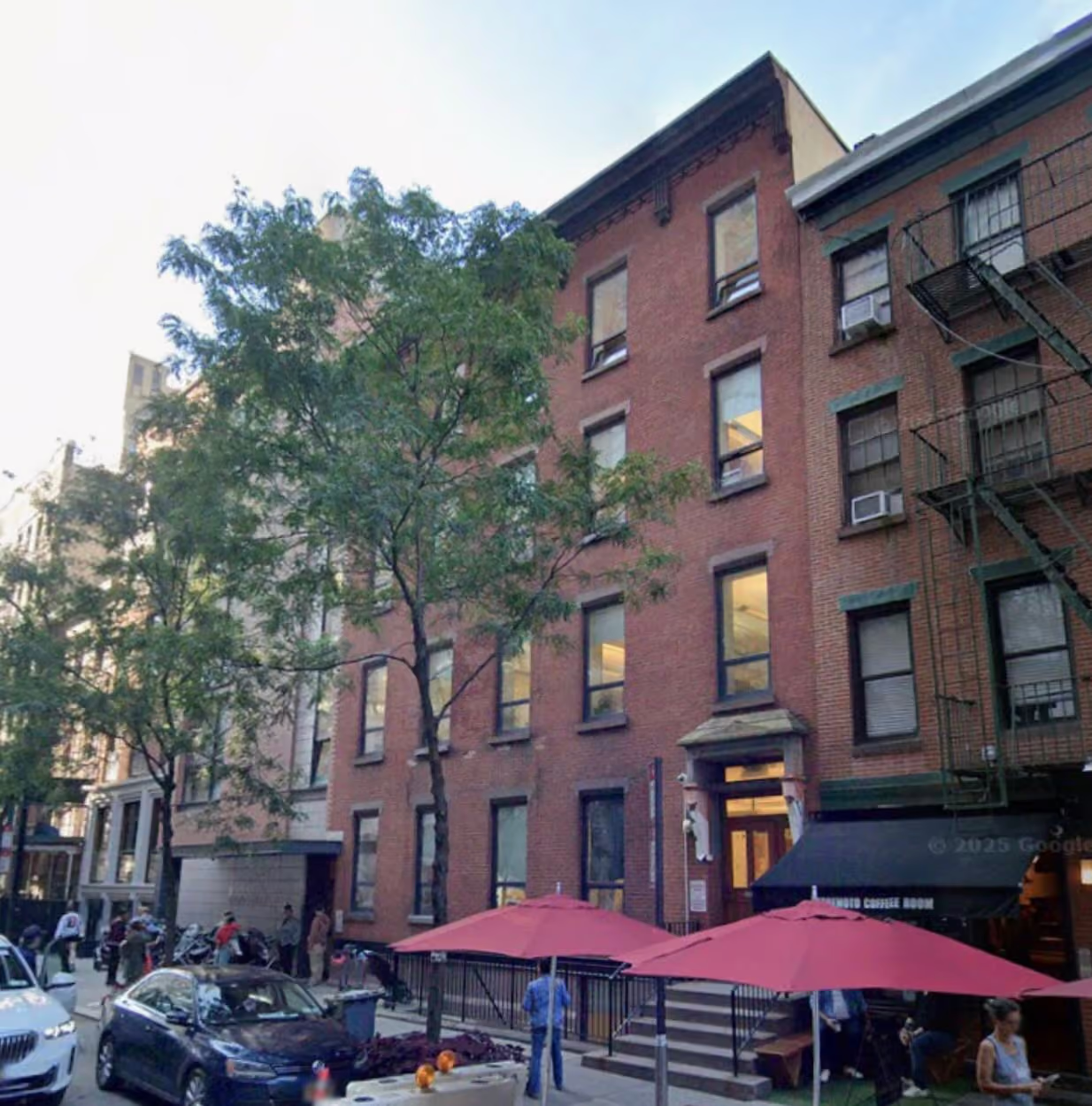

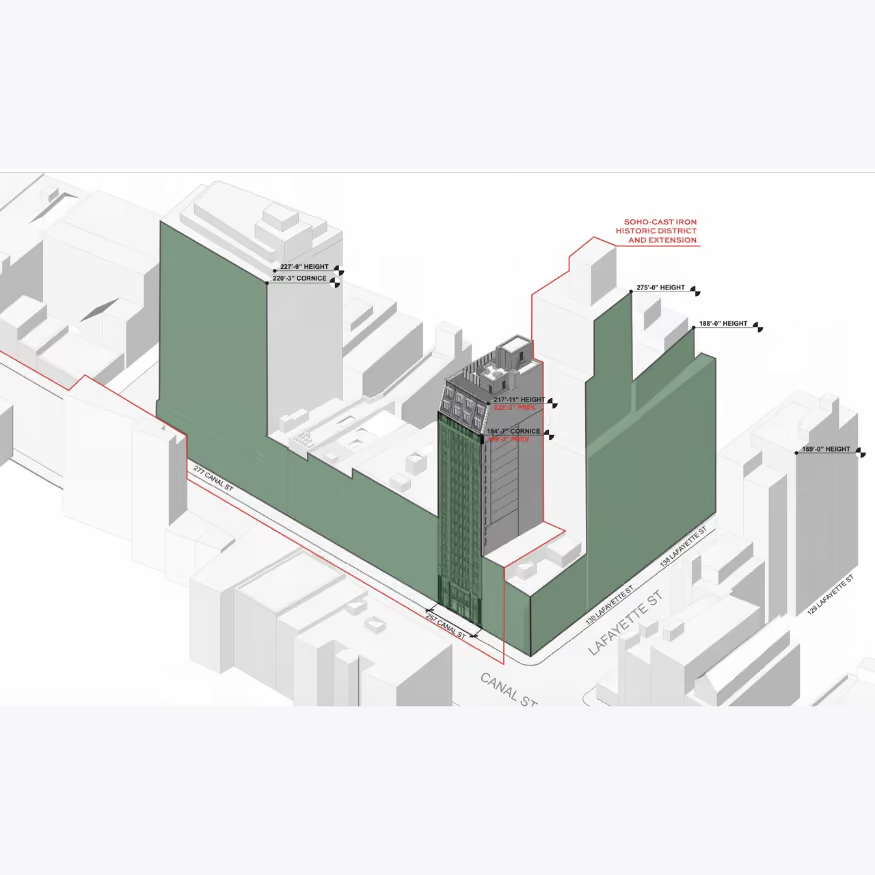



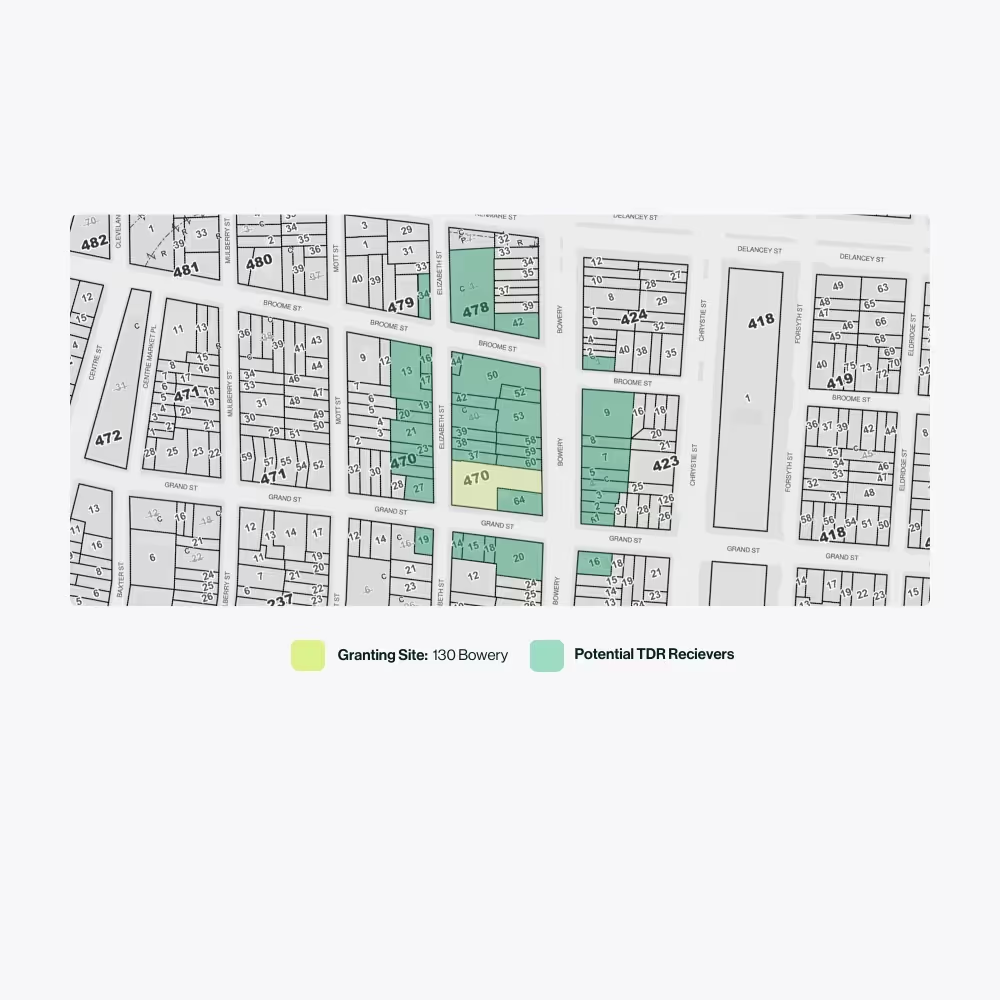


.avif)
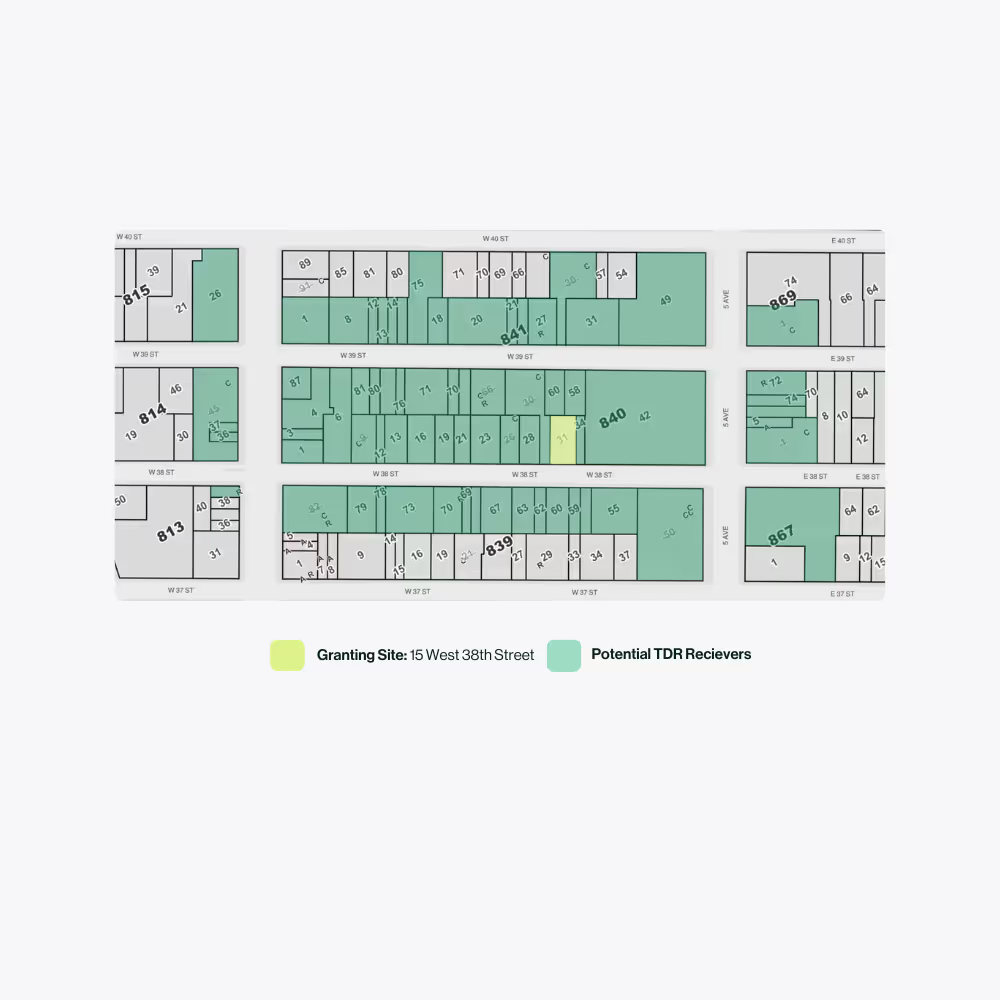
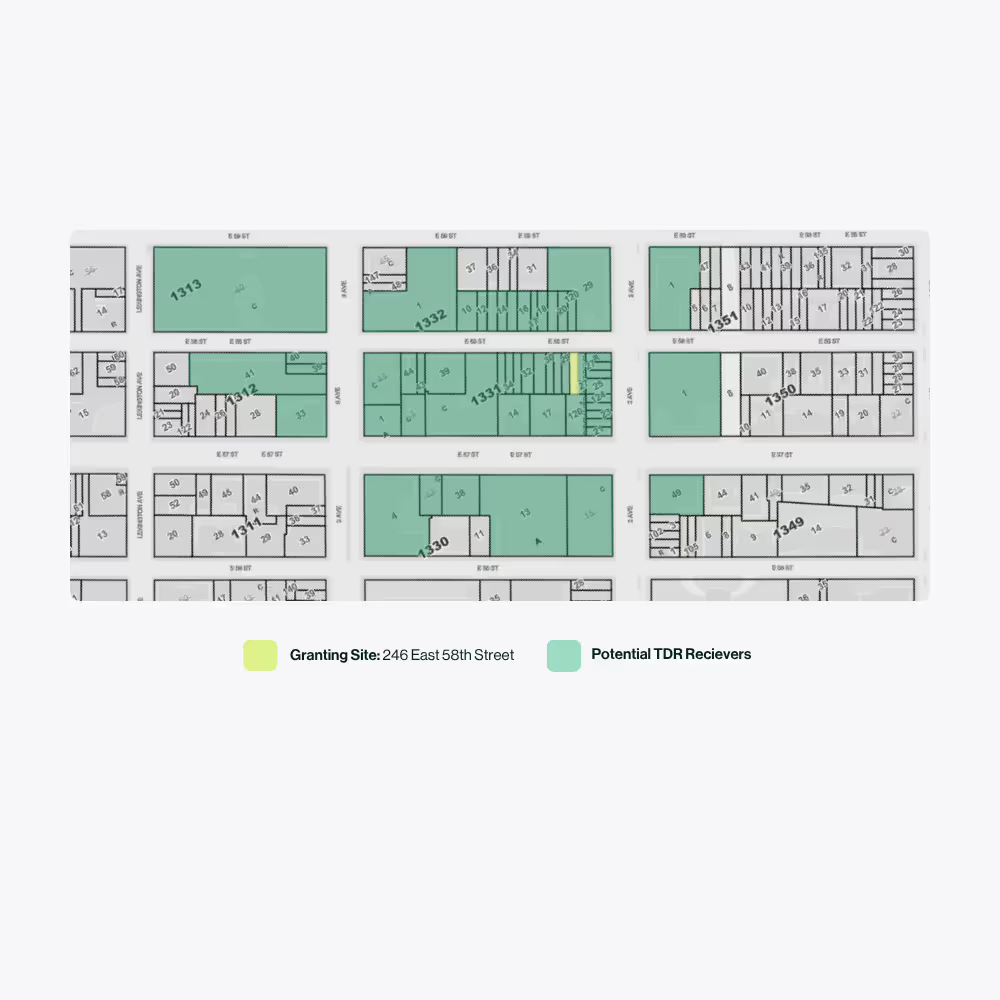
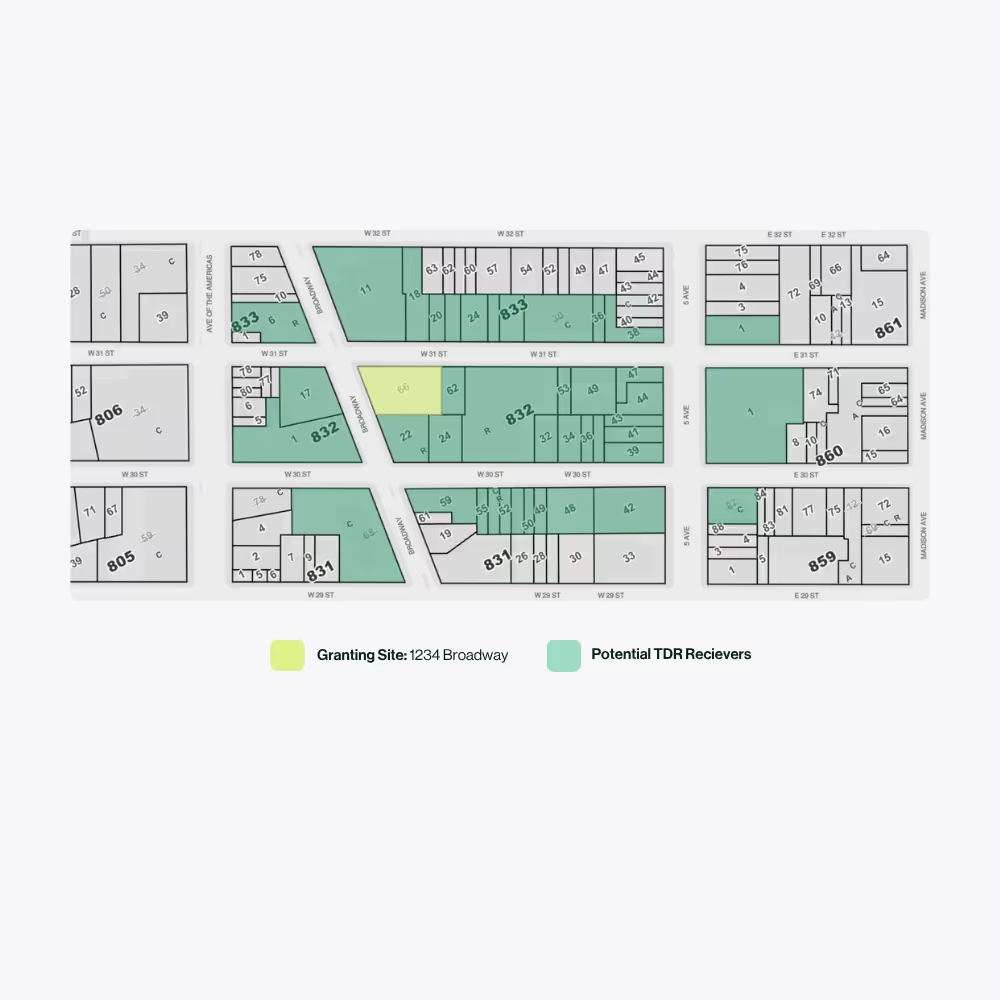


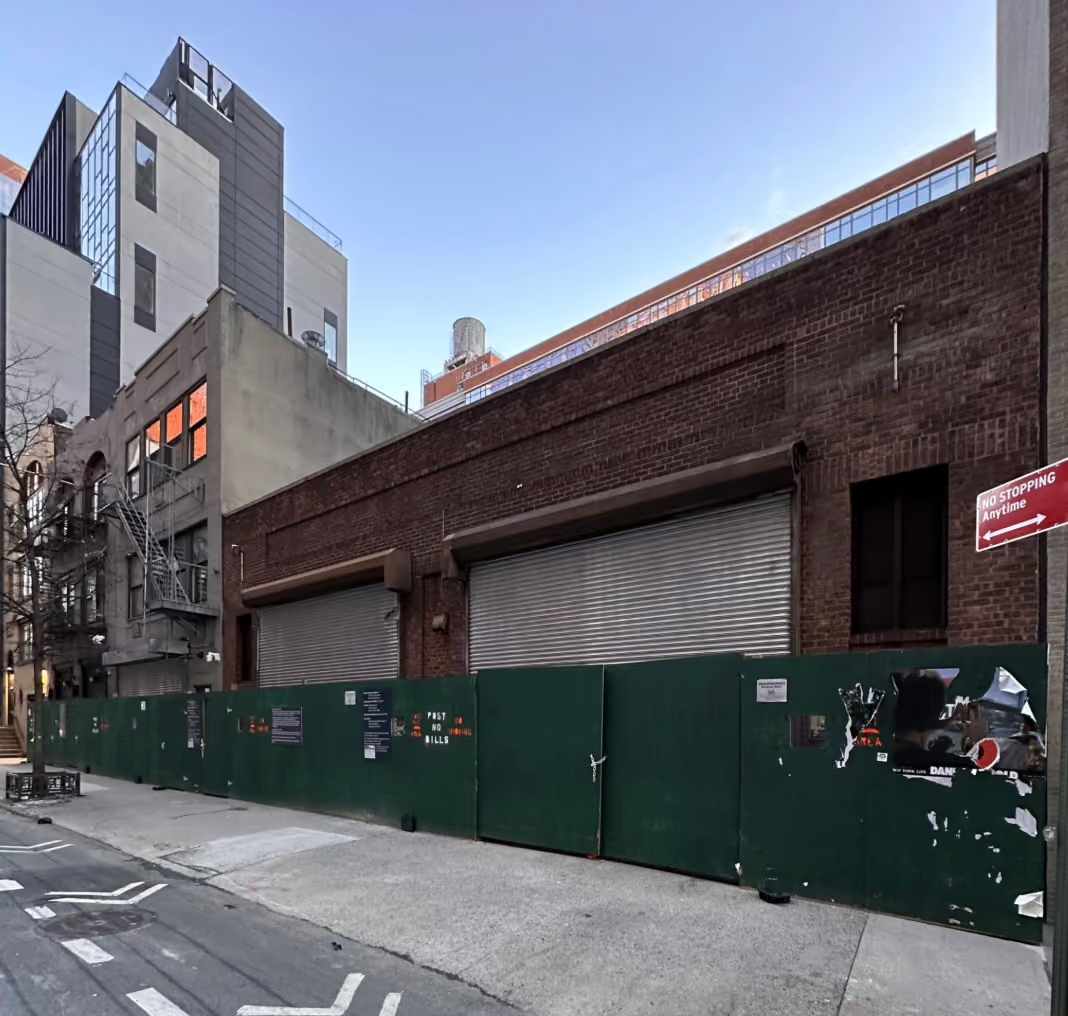
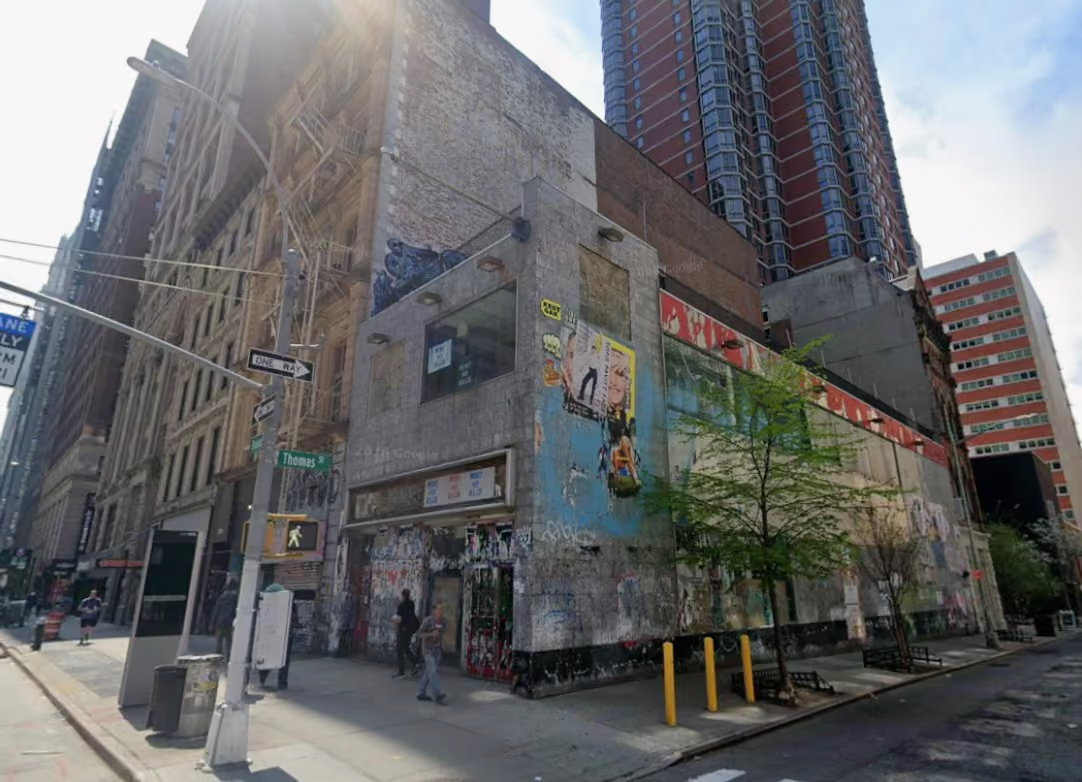



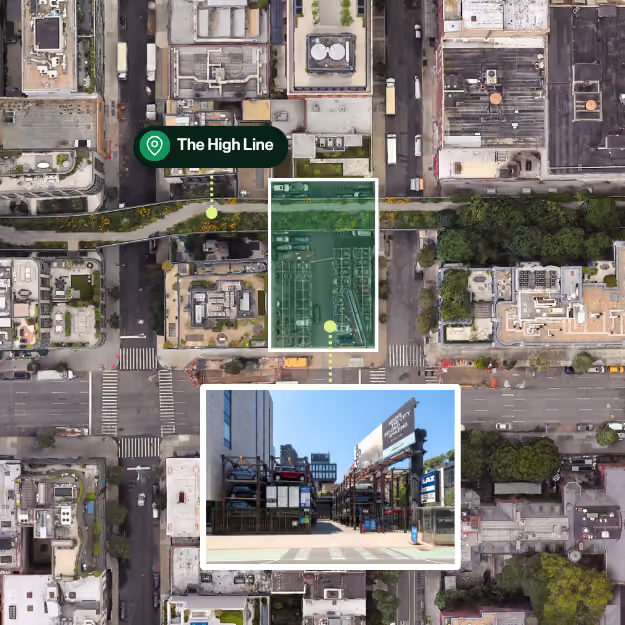
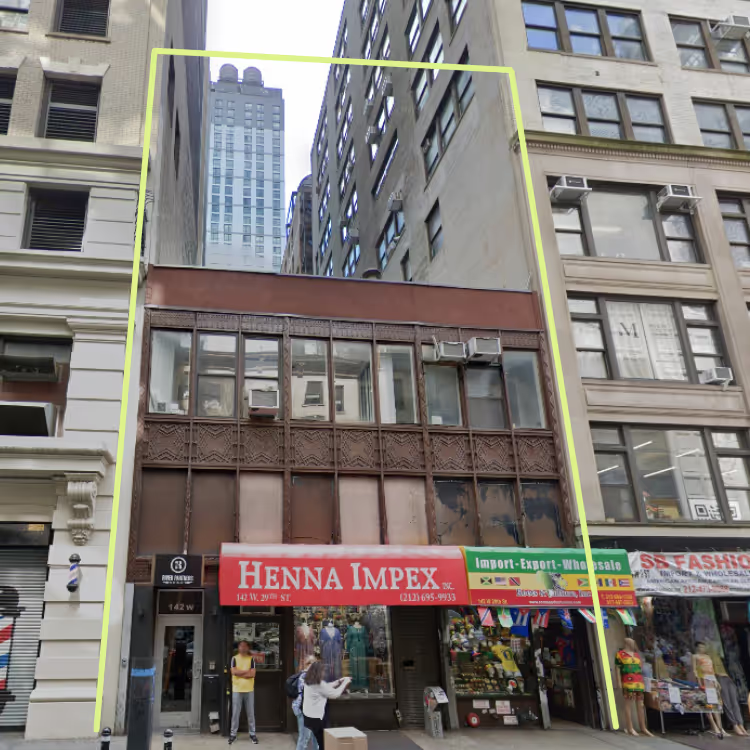
.avif)





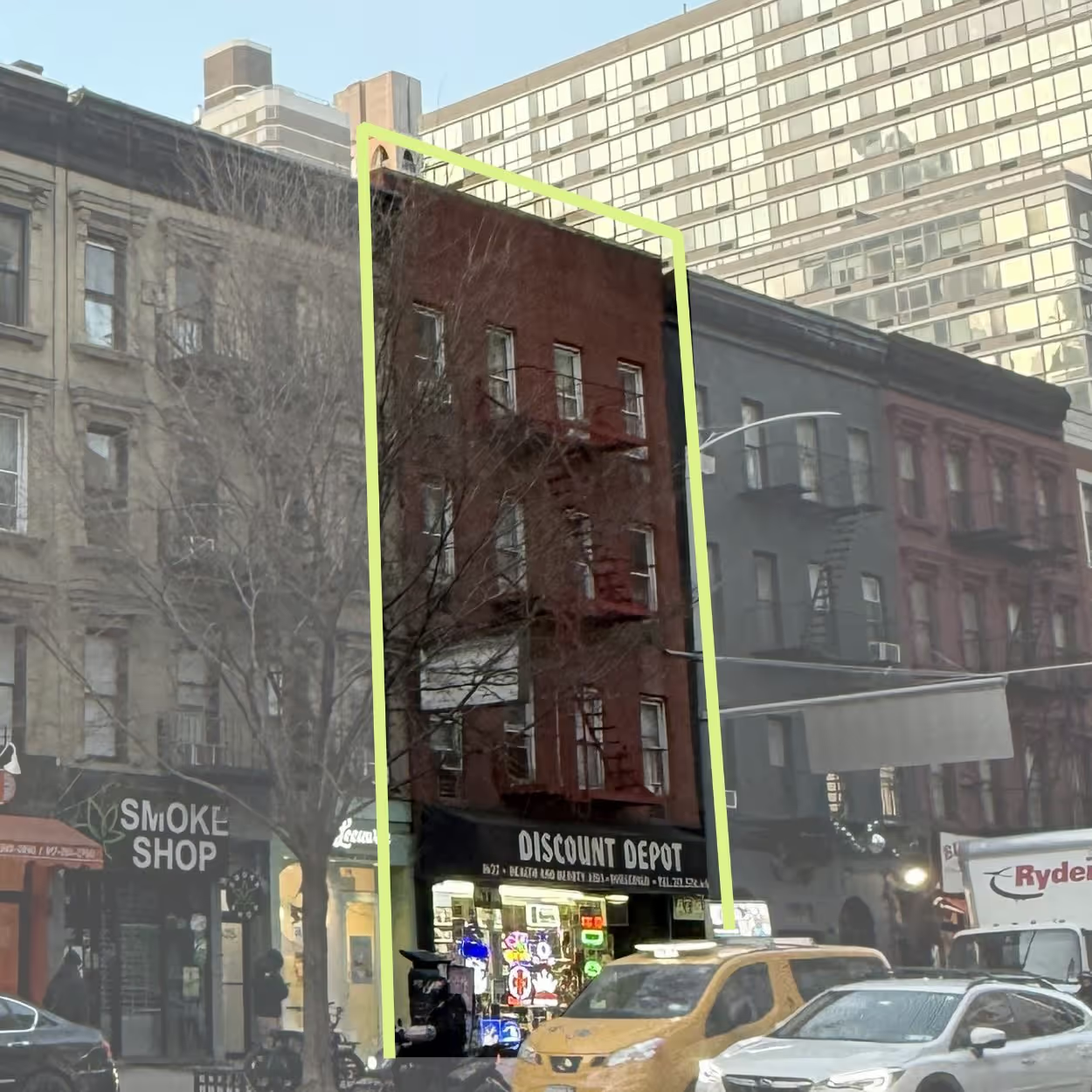









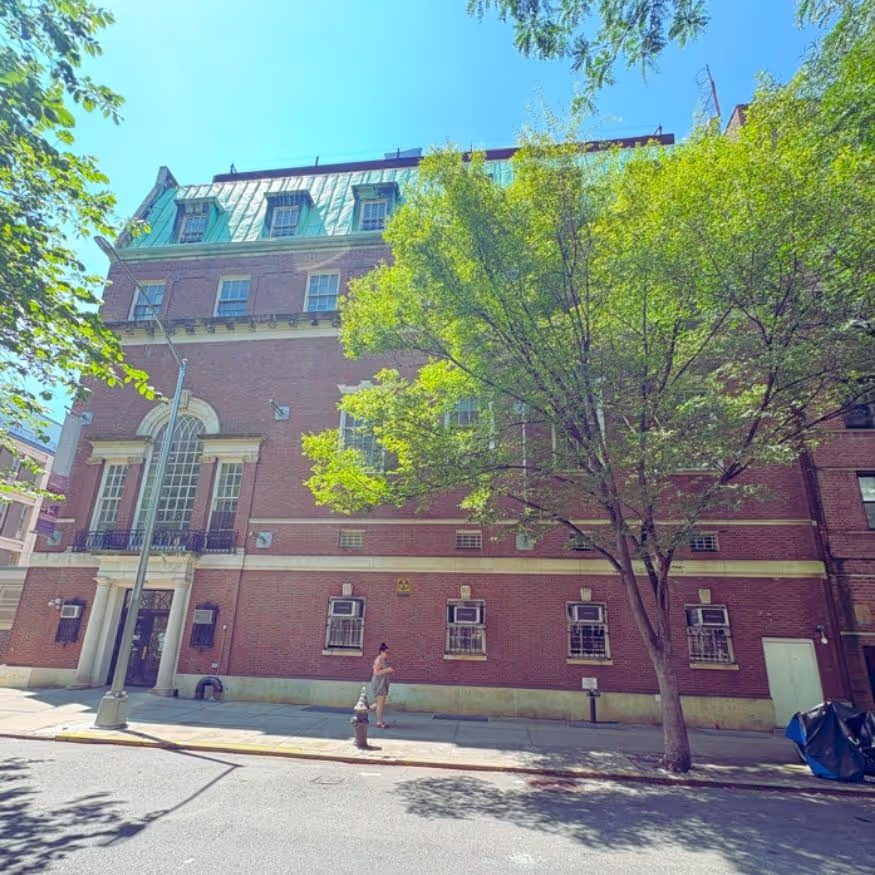


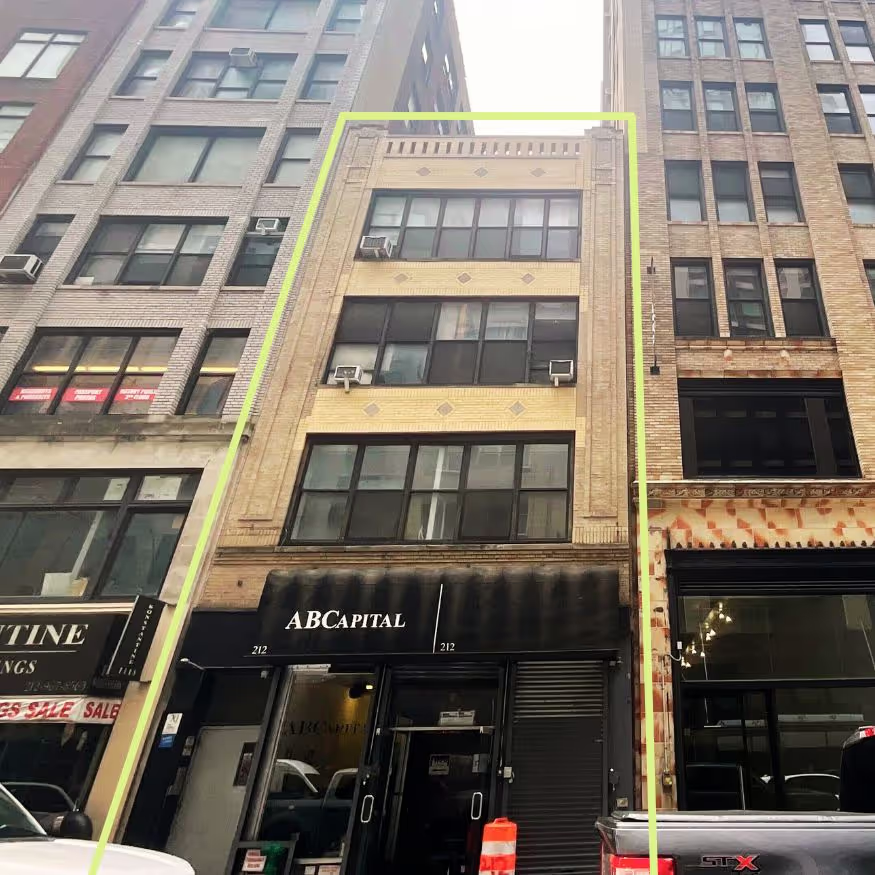


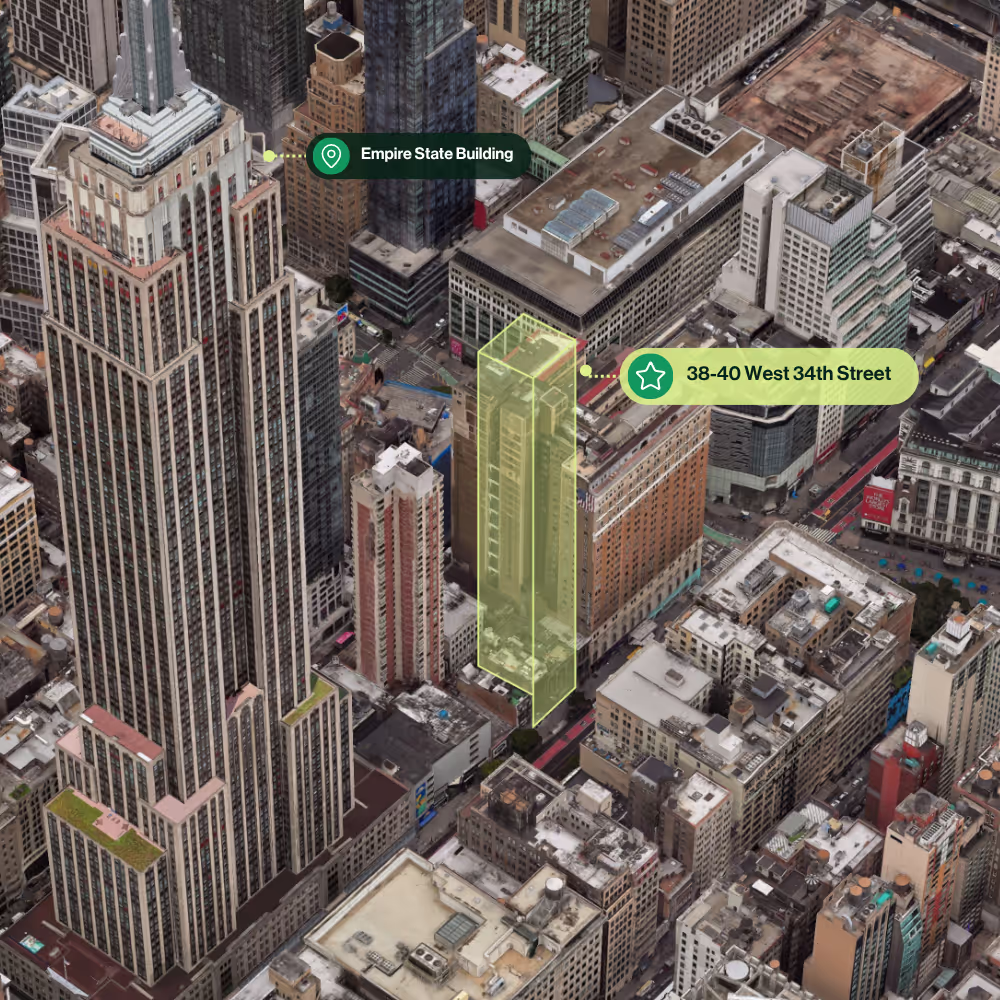




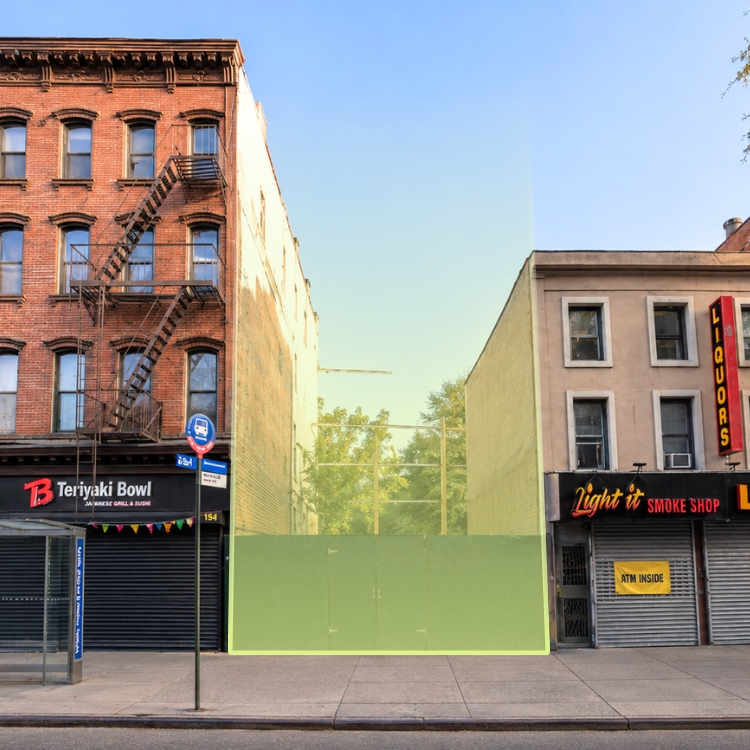
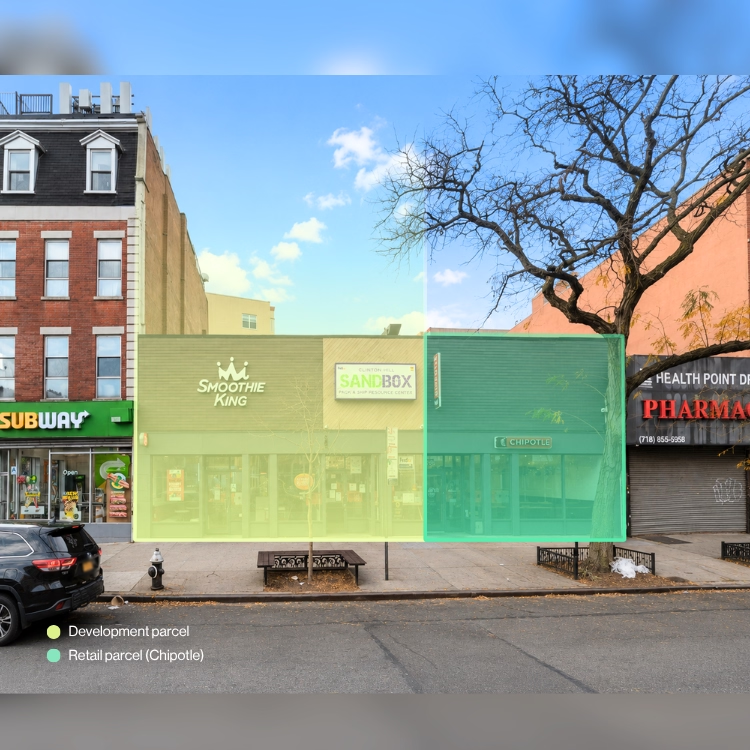


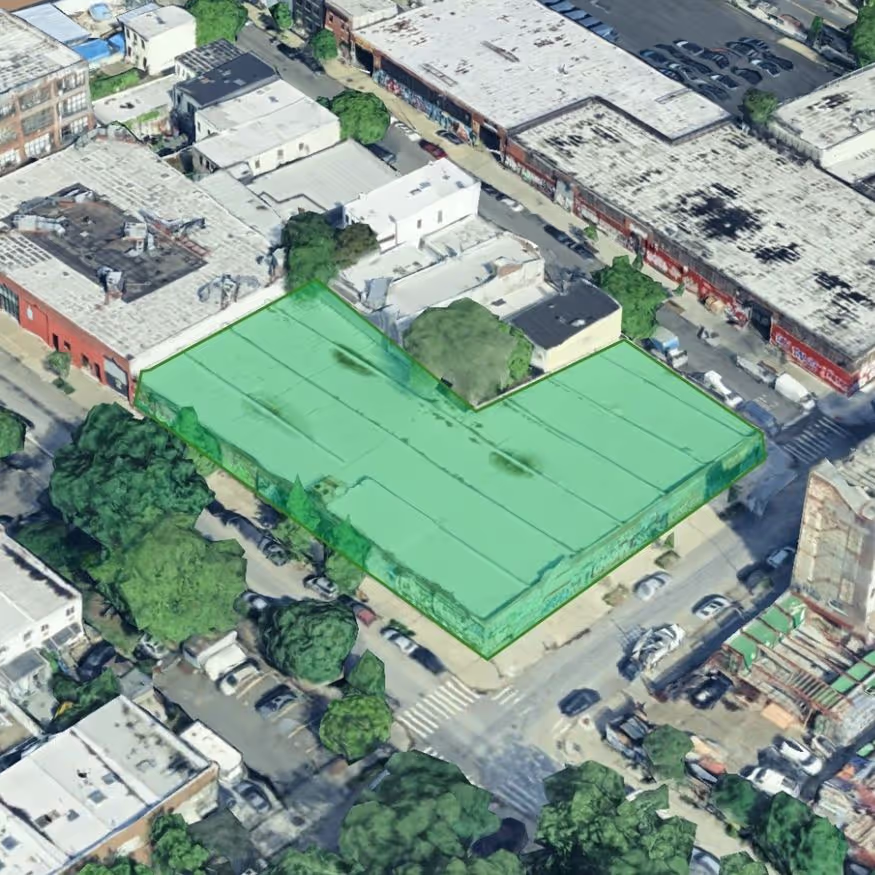

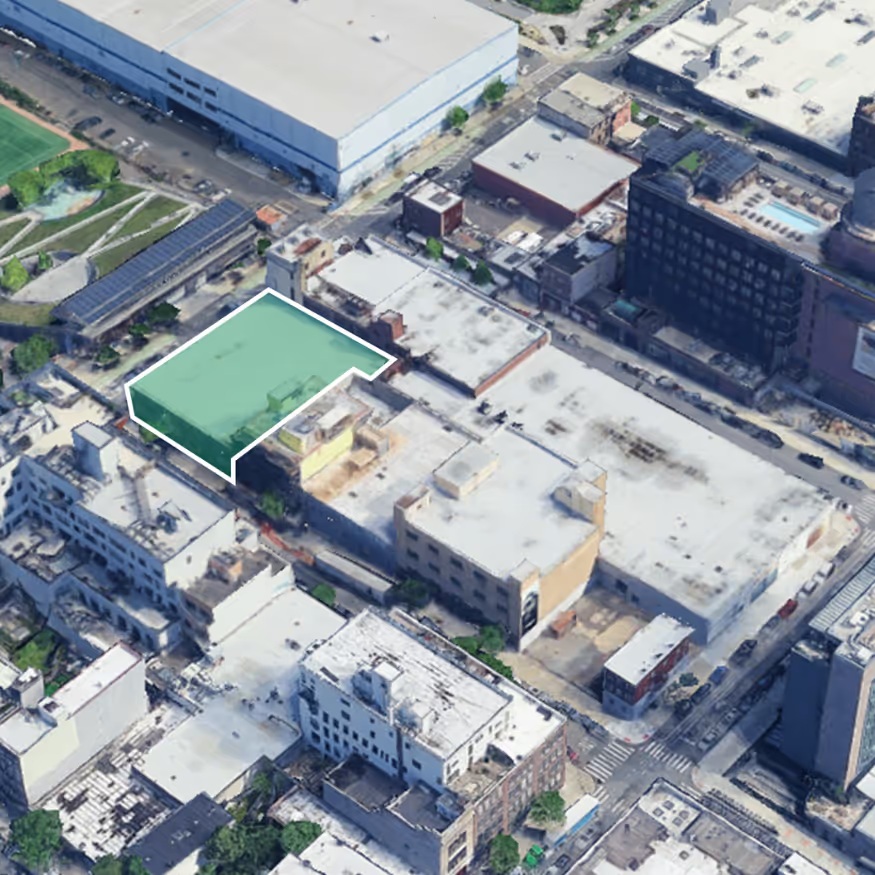

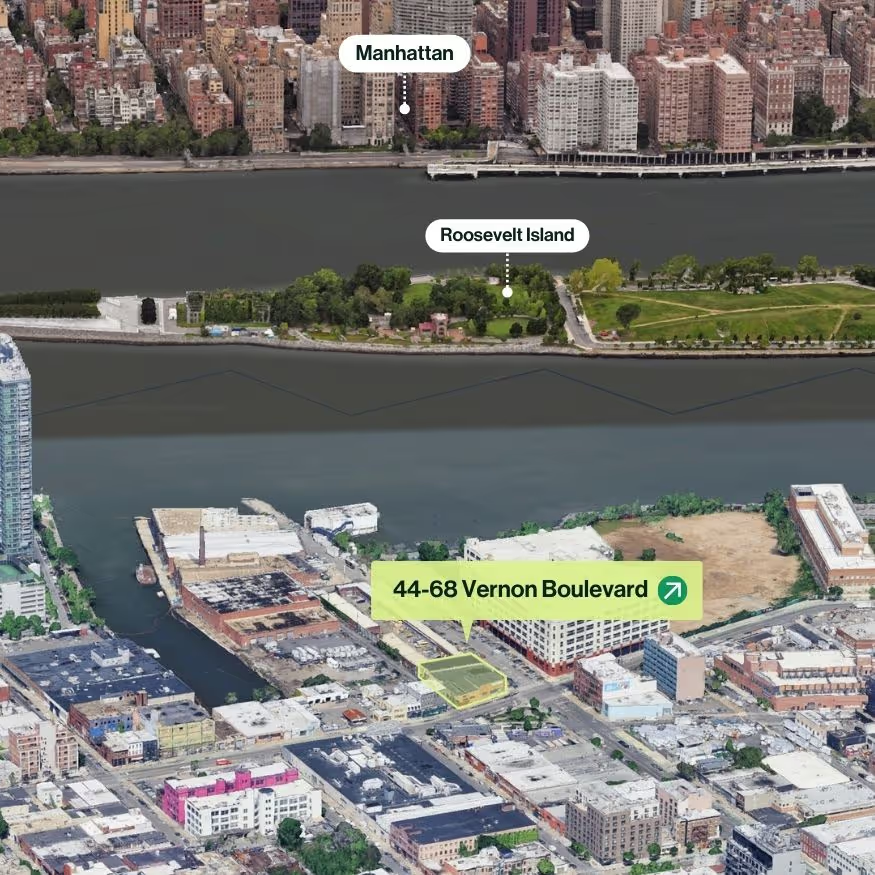


.avif)